Multiple Income Streams After 40: Your Realistic Roadmap to Financial Freedom
You’re 45, staring at your bank account, and thinking: “Is this really all I have to show for 20+ years of working?”
Your job pays the bills—barely—but one unexpected expense, one layoff, one medical emergency, and everything falls apart. You know you need more than one income stream, but where do you even start?
Maybe you’re a teacher who’s been in the classroom for two decades, making $55k a year with no raises in sight. Or you’re in construction, and your body’s starting to remind you that you can’t do this forever. Perhaps you’re in middle management at a company that just announced “restructuring” for the third time in five years.
Here’s the truth: creating multiple income streams after 40 isn’t just possible—it’s essential. And you don’t need a business degree, a trust fund, or some guru’s $5,000 course to do it.
You need a realistic roadmap that works for real guys with real responsibilities. This is that roadmap.
Disclosure
This article contains affiliate links. If you choose to make a purchase through these links, we may earn a commission at no additional cost to you.
Why One Income Stream Isn’t Enough Anymore (And What to Do About It)

Let’s be honest: the world our parents worked in doesn’t exist anymore.
Back then, you got a job at 22, worked there for 40 years, got a gold watch and a pension, and retired comfortably. That system is dead. Companies don’t offer pensions anymore. “Loyalty” doesn’t guarantee job security. And inflation means your salary from five years ago buys a lot less today.
Here’s what’s changed:
The Job Market Is Unstable
Layoffs happen without warning. Industries disappear overnight (remember Blockbuster? Kodak?). Even “safe” careers like banking and tech have seen massive downsizing. Relying on one employer for your entire financial future is like building your house on sand.
Your Expenses Keep Growing
Kids’ college tuition. Aging parents who need help. Medical bills that insurance doesn’t cover. Your mortgage, car payment, groceries—everything costs more every year. Meanwhile, your salary stays flat or grows at 2-3% if you’re lucky.
Retirement Isn’t What It Used to Be
Social Security might cover your groceries in retirement—maybe. Your 401(k) took a hit in 2008, and probably again in 2020, and who knows when the next crash is coming. If you’re 45 now and want to retire at 65, that’s only 20 years to build enough wealth to live on for potentially 30+ years.
The solution? Multiple income streams.
Think of it like this: if you have one income stream and it disappears, you’re at 0%. But if you have four income streams and one disappears, you’re still at 75%. That’s not just financial security—that’s peace of mind.
Building multiple income streams requires developing the right psychological framework. Just like building physical strength, mental resilience becomes your foundation for financial growth. You’ll need to overcome the fear of change and push through the discomfort of trying something new.
The Biggest Myths About Creating Income Streams After 40
Before we dive into the “how,” let’s kill some myths that might be holding you back.
Myth #1: “I’m Too Old to Start Something New”
Reality: You’re not too old—you’re actually in the perfect position.
At 40+, you have something 25-year-olds don’t: experience, credibility, and a professional network. You know how businesses work. You understand people. You’ve solved problems for years. That’s valuable.
Meet Tom. He’s 48, works in IT, has two kids in high school, and barely has time to breathe. He started with one simple side hustle: consulting for small businesses on weekends. Two hours on Saturday mornings. That’s it.
Twelve months later, he’s making an extra $800/month—enough to finally start his emergency fund and stop living paycheck to paycheck. Tom didn’t need to be 25. He needed to be experienced enough that small businesses trusted his advice. Age was an advantage, not a barrier.
Myth #2: “I Don’t Have Time with My Current Job”
Reality: You don’t need 40 hours a week. You need 3-5 strategic hours.
Nobody’s saying quit your job and go all-in on a business idea. That’s reckless. What we’re talking about is finding 5 hours a week—maybe two hours on Saturday morning and three hours on Sunday afternoon—to build something on the side.
That’s one Netflix binge. One football game. One lazy morning scrolling social media. You have the time—you just need to redirect it.
Myth #3: “I Need Thousands of Dollars to Invest”
Reality: You can start with $25-50/month.
Seriously. Most people think “investing” means you need $10,000 sitting around. Not true. With apps like Vanguard, Fidelity, or even Robinhood, you can start investing with $25.
Can’t spare $25? Start with $10. The amount doesn’t matter as much as the habit. Once you start, you’ll find ways to increase it. Learn how to start investing with just $25 and build from there.
Myth #4: “Passive Income Is a Scam”
Reality: Some passive income schemes are scams. Real passive income takes work upfront.
Yes, those “make $10,000/month while you sleep” ads are garbage. But real passive income—like dividend-paying stocks, rental properties, or digital products—is absolutely real. The catch? It’s not passive at first. You put in work upfront (buying the property, creating the course, building the portfolio), and then it generates income with minimal effort.
Think of it like planting a tree. You dig the hole, plant the seed, water it, protect it. That’s work. But five years later, that tree gives you shade and fruit without you doing anything. That’s passive income.
The 4-Stream Income Framework: Your Roadmap
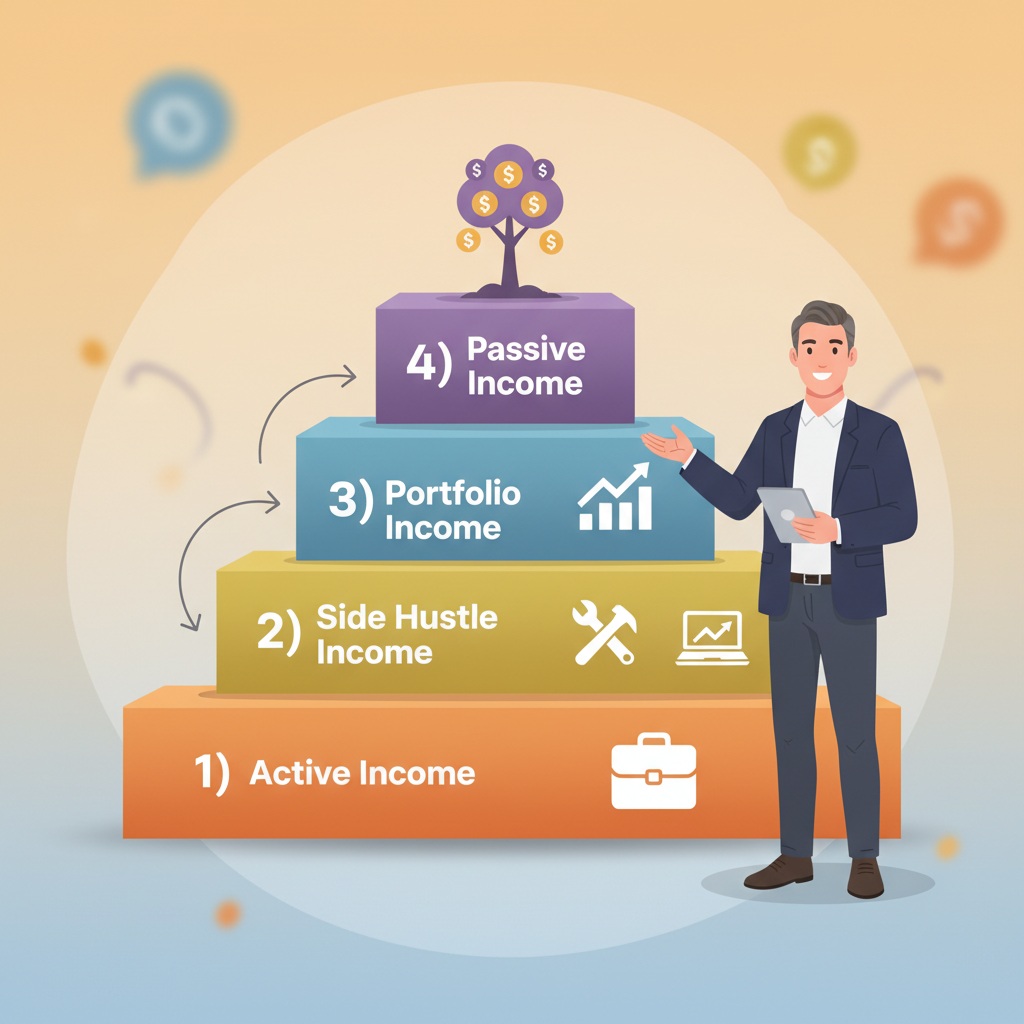
Here’s the framework that actually works for guys over 40. It’s not sexy, it’s not a get-rich-quick scheme, but it’s realistic and proven.
Think of these four income streams as building blocks. You don’t need all four on Day 1. You build them in order, one at a time, using each stream to fund the next.
Stream 1: Active Income (Your Day Job—Optimize It First)
What it is: Trading your time directly for money. Your salary, hourly wage, or freelance work where you’re actively working to get paid.
Why it matters: This is your foundation. Before you chase passive income or side hustles, make sure you’re maximizing what you already have.
How to optimize it:
- Negotiate your salary. Most guys never ask for a raise. If you’ve been at your job for 2+ years without a raise, you’re leaving money on the table. Research what others in your role make (use sites like Glassdoor or Salary.com) and make your case.
- Upskill strategically. What skill would make you more valuable? If you’re in sales, maybe it’s learning CRM software. If you’re in trades, maybe it’s getting a certification that lets you charge more. Invest in skills that directly increase your earning power.
- Side up, not out. Look for opportunities within your current company. Can you take on a higher-paying project? Move to a better-paying department? Sometimes the best “new job” is at your current employer.
Real example: Mike, 52, works in HVAC. He got his EPA certification (cost: $200, time: 2 weeks). That certification let him work on commercial systems, which bumped his hourly rate from $28 to $38. That’s an extra $20,800/year for a $200 investment.
Your active income funds everything else. Understanding the Triangle of Well-being helps you see how your physical energy, mental clarity, and financial stability all work together—you need energy to maximize your day job.
Stream 2: Side Hustle Income (Trade Time for Money, But on Your Terms)
What it is: Using your existing skills to earn extra money outside your 9-to-5. You’re still trading time for money, but YOU control when, how much, and for whom.
Why it matters: This is the fastest way to add $500-2,000/month to your income. It requires no upfront investment (usually), and you can start this weekend.
Best side hustles for professionals over 40:
Consulting/Freelancing in Your Field
If you’ve been in your industry for 10+ years, you know things that small businesses or startups desperately need to know.
- Platforms to use: Upwork, Fiverr, LinkedIn ProFinder, or just reach out directly to businesses in your area
- What to charge: $75-150/hour depending on your expertise
- Time commitment: 5-10 hours/week
- Real example: Sarah, 46, is a marketing manager. She started doing freelance social media strategy for local restaurants on weekends. Three clients at $500/month each = $1,500 extra monthly income.
Skilled Trades/Handyman Work
If you’re good with your hands, people will pay you well.
- Platforms: TaskRabbit, Thumbtack, Nextdoor, or word-of-mouth
- What to charge: $40-80/hour for general handyman work, more for specialized skills
- Time commitment: Weekends, evenings
- Real example: Dave, 49, does furniture assembly and TV mounting on weekends. Four jobs per weekend at $100-150 each = $800-1,200/month.
Tutoring/Teaching
Got expertise in math, music, a foreign language, or a professional skill? Parents and adults will pay for that knowledge.
- Platforms: Wyzant, Tutor.com, or local community centers
- What to charge: $30-60/hour depending on subject
- Time commitment: 3-5 hours/week
- Real example: James, 51, tutors high school math three evenings a week. $40/hour × 6 hours/week = $960/month.
The key: Pick ONE side hustle. Don’t try to do five things at once. Master one, get three clients, then decide if you want to scale it or try something else.
Starting your first side hustle requires breaking through mental blocks and taking action despite fear. That’s where building mental toughness becomes critical.
What it is: Money earned from investments—stocks, bonds, mutual funds, ETFs. This is where your money works for you instead of you working for money.
Why it matters: This is how you build long-term wealth. Your side hustle might make you $1,000/month now, but your investment portfolio can grow to $500,000+ over 20 years.
How to start (even with $25):
Index Funds: The “Set It and Forget It” Strategy
Index funds are collections of stocks that track the overall market (like the S&P 500, which tracks the 500 biggest U.S. companies). Instead of picking individual stocks (risky), you own a tiny piece of hundreds of companies.
- Where to invest: Vanguard, Fidelity, Charles Schwab
- What to buy: Look for “S&P 500 Index Fund” or “Total Stock Market Index Fund”
- How much: Start with $25-50/month and increase as you can
- Expected return: Historically, the stock market returns about 10% per year on average (some years more, some less)
Simple math: If you invest $200/month starting at age 45, by age 65 (20 years), you’ll have roughly $152,000 (assuming 10% annual return). That’s $48,000 you put in, and $104,000 in growth. That’s your money working for you.
Dividend Stocks: Get Paid Just for Owning
Some companies pay you cash (called “dividends”) just for owning their stock. Think of it like rent—you own the property (stock), and they pay you regularly.
- Examples: Coca-Cola, Johnson & Johnson, Procter & Gamble (these are stable, boring companies that have paid dividends for decades)
- How much: Dividend yields typically range from 2-5% per year
- Real example: If you own $10,000 worth of a stock with a 4% dividend yield, you get $400/year in cash payments (usually paid quarterly)
Important: Investing has risks. The market goes up and down. Never invest money you need in the next 5 years. This is long-term wealth building, not a get-rich-quick scheme. Understanding how mental resilience impacts financial decisions helps you stay calm during market volatility.
Stream 4: True Passive Income (The Long Game)
What it is: Income that continues to flow with minimal ongoing effort. You do the work once, and it pays you repeatedly.
Realistic passive income options:
Why it matters: This is financial freedom. When your passive income covers your expenses, you can choose to work—or not.
Rental Property
Buy a property, rent it out, collect monthly rent checks.
- Upfront cost: Down payment (usually 20-25% of property price) + closing costs
- Monthly income: Depends on location, but aim for $200-500/month profit after mortgage, taxes, insurance, and maintenance
- Time commitment: 5-10 hours/month managing tenants and maintenance (or hire a property manager for 8-10% of rent)
- Real example: Carlos, 47, bought a small duplex for $180,000 (put down $36,000). He lives in one unit and rents the other for $1,200/month. His mortgage is $900/month, so the rental income covers most of his housing cost.
Caution: Real estate isn’t truly “passive.” Toilets break. Tenants move out. But it’s less active than a side hustle.
Digital Products (E-books, Courses, Templates)
Create something once, sell it forever.
- Upfront cost: Time (50-200 hours to create quality content)
- Monthly income: Highly variable—could be $50/month or $5,000/month depending on audience and marketing
- Platforms: Amazon Kindle, Gumroad, Teachable, Udemy
- Real example: Linda, 44, created a course teaching administrative assistants how to master Excel. Took her 3 months to create. Now sells 10-15 copies/month at $49 each = $500-750/month passive income.
Affiliate Marketing/Niche Websites
Build a website around a specific topic, create helpful content, and earn commissions when people buy products you recommend.
- Upfront cost: Domain + hosting ($100-200/year) + your time
- Monthly income: $100-2,000/month once established (takes 6-12 months to build)
- Real example: Kevin, 50, built a website reviewing camping gear. He earns affiliate commissions from Amazon when readers buy products he recommends. Income: $800-1,200/month.
The truth about passive income: It takes 6-24 months of active work before it becomes truly passive. Don’t believe anyone who says otherwise.

Your First 90 Days: The Income Stream Starter Plan

Okay, you’re convinced. You’re ready to start. But where do you actually begin?
Here’s your 90-day roadmap. Follow this, and in three months you’ll have at least one new income stream started and momentum toward building more.
Month 1: Audit and Foundation
Week 1: Take Inventory
Sit down with a notebook (or your phone) and answer these questions:
- What skills do I have? (Think beyond your job title—can you fix things? Teach? Write? Organize? Manage projects?)
- What do people ask me for help with? (Friends, family, coworkers—what do they come to you for?)
- How much time do I realistically have? (Be honest. 3 hours/week? 10 hours/week?)
- What’s my current financial situation? (Income, expenses, debt, savings)
Week 2: Clear the Debt (If You Have It)
Before you build income streams, you need to stop the bleeding. If you’re carrying high-interest credit card debt (15%+ interest), that’s costing you money every single day.
Follow the debt freedom roadmap to tackle this strategically. You don’t need to be debt-free to start building income streams, but you need a plan to get there.
Week 3: Set Up Your Financial Foundation
Open a separate bank account for your side income. Even if it’s empty right now, having it ready makes everything easier. When that first $200 hits, you’ll feel the momentum.
Also, if you don’t have one already, create your first emergency fund. Even $500-1,000 gives you breathing room.
Week 4: Pick Your First Income Stream
Based on your Week 1 inventory, choose ONE income stream to pursue. Not three. Not “I’ll try everything and see what works.” ONE.
Decision framework:
- Need money fast? → Side hustle (consulting, handyman work, tutoring)
- Have $25-50/month to invest? → Start portfolio income (index funds)
- Have time but no money? → Side hustle first, then use that income to fund investments
Month 2: Launch Your First Stream
Week 5-6: Set Up Your Side Hustle
If you chose a side hustle, this is your launch phase.
Action steps:
- Create profiles on 2-3 platforms (Upwork, Fiverr, TaskRabbit, LinkedIn—whatever fits your skill)
- Set your rates (Start slightly below market rate to get your first 2-3 clients and reviews, then raise prices)
- Tell everyone you know (Post on Facebook, tell friends, email former colleagues—”Hey, I’m now offering [service]. Know anyone who needs help?”)
Week 7: Get Your First Client
Your goal: land ONE paying client. Even if it’s just $50. That first dollar you earn from something YOU built hits different.
Pro tip: Your first client will probably come from someone you know, not a random platform. Don’t be shy—tell people what you’re doing.
Week 8: Deliver Amazing Work
Overdeliver for your first few clients. Get testimonials. Ask for referrals. These first clients are your foundation for future growth.
OR, if you chose investing:
Week 5-8: Set Up Automated Investing
- Open an account with Vanguard, Fidelity, or Charles Schwab
- Choose an index fund (S&P 500 or Total Stock Market)
- Set up automatic monthly contributions (even if it’s just $25)
- Don’t check it every day (Seriously. The market goes up and down. You’re in this for 20+ years.)
Learn how to automate your finances so investing becomes a habit, not a decision you make every month.
Month 3: Build Momentum and Add Stream #2
Week 9-10: Optimize What’s Working
By now, you should have some data. Did your side hustle land clients? Is your investment account growing (even slowly)?
For side hustlers:
- Raise your rates 10-20% for new clients
- Ask current clients for referrals
- Streamline your process (templates, systems, faster turnaround)
For investors:
- Increase your monthly contribution by $10-25 if possible
- Read one book on investing (see recommendations below)
Week 11-12: Start Planning Stream #2
Don’t abandon Stream #1, but start thinking about what’s next.
If you started with a side hustle: Begin investing a portion of that income. Even $50/month from your side hustle into an index fund starts building long-term wealth.
If you started with investing: Consider a micro side hustle to accelerate your investment contributions. An extra $200/month from tutoring or freelancing can double or triple your investment rate.
Tools and Resources You Actually Need
Let’s cut through the noise. Here are the tools that actually help, organized by income stream.
For Side Hustles
Platforms to find clients:
- Upwork (best for professional services—writing, design, consulting)
- Fiverr (best for quick, defined services—logo design, voiceovers, editing)
- TaskRabbit (best for physical tasks—moving, assembly, handyman work)
- Thumbtack (best for local services—home repair, tutoring, personal training)
- LinkedIn (best for B2B consulting—just reach out directly to businesses)
Tools to manage your side hustle:
- Wave (free invoicing and expense tracking)
- Google Calendar (block out your side hustle hours so you actually do the work)
- Notion or Trello (track clients, projects, and to-dos)
For Investing
Investment platforms:
- Vanguard (best for low-cost index funds, great for long-term investors)
- Fidelity (similar to Vanguard, excellent customer service)
- Charles Schwab (good all-around option, easy-to-use app)
Learning resources:
- The Simple Path to Wealth by JL Collins—the best book for beginners who want to understand index fund investing
- The Intelligent Investor by Benjamin Graham—if you want to go deeper into value investing
Tracking tools:
- Empower (free tool to track all your investments in one place)
- Mint or YNAB (You Need A Budget) (track spending and find money to invest)
For Passive Income
Real estate:
- BiggerPockets (website and podcast—everything you need to learn about rental properties)
- Zillow/Redfin (research property prices and rental rates in your area)
Digital products:
- Gumroad (easiest platform to sell digital products—ebooks, templates, guides)
- Teachable or Udemy (create and sell online courses)
- Amazon Kindle Direct Publishing (publish and sell ebooks)
Affiliate marketing:
- Amazon Associates (easiest affiliate program to start with)
- ShareASale or CJ Affiliate (more affiliate options once you have traffic)

If you want to deepen your knowledge, grab, "The Simple Path to Wealth" by JL Collins. It breaks down money management for regular guys without the jargon.
Common Mistakes to Avoid (Learn from Others’ Failures)
Mistake 1:
Trying to Build All Four Streams at Once
Why it fails: You spread yourself too thin, make no real progress on anything, and burn out in 6 weeks.
What to do instead: Pick ONE stream. Master it. Get it generating income. THEN add the next one.
Mistake 2:
Quitting Your Job Too Soon
Why it fails: Your side hustle is making $800/month and you think “I’m an entrepreneur now!” and quit your $60k job. Then your side hustle income drops, you panic, and you’re scrambling.
What to do instead: Don’t quit your job until your side income consistently covers your expenses for at least 6-12 months. Even then, think hard about it.
Mistake 3:
Not Tracking Your Money
Why it fails: You’re making extra money from your side hustle, but you’re also spending more because “I’m making more now.” Six months later, you have nothing to show for it.
What to do instead: Every dollar from your side hustle should have a job—pay off debt, build emergency fund, invest, or fund the next income stream. Track it.
Mistake 4:
Ignoring Taxes
Why it fails: You make $10,000 from your side hustle, spend it all, and then owe $2,500 in taxes you don’t have.
What to do instead: Set aside 25-30% of your side hustle income for taxes. Open a separate savings account and put it there. When tax time comes, you’re covered.
Mistake 5:
Giving Up After 3 Months
Why it fails: You start a side hustle, it’s slow at first, you get discouraged, and you quit just before it would’ve taken off.
What to do instead: Commit to 6-12 months minimum. Most income streams take time to build. Building mental resilience through small wins helps you stay consistent even when results are slow.
Managing Your Energy: The Physical and Mental Side
Here’s what nobody tells you about building multiple income streams: it’s not just about time and money—it’s about energy.
You can’t work your 9-to-5, hustle on weekends, and build wealth if you’re exhausted, stressed, and running on fumes.
Physical wellness matters:
- Sleep optimization is non-negotiable. You need 7-8 hours. No, you can’t “hustle” on 5 hours of sleep long-term.
- Sustainable fitness routines give you the energy to work your job AND your side hustle without burning out.
- Nutrition matters. You can’t build wealth if you’re living on fast food and energy drinks.
Mental resilience matters:
- Breaking through mental blocks when fear and doubt creep in
- Weekly planning with a Sunday reset keeps you organized and prevents overwhelm
- Understanding that health, mind, and money are connected—you can’t optimize one without the others
Final Thoughts: It’s Not Too Late

You’re not too old. You’re not too far behind. You’re not “stuck” forever.
Creating multiple income streams after 40 is about taking control of your financial future instead of hoping your employer, the government, or luck will take care of you.
“The journey of a thousand miles begins with a single step—and sometimes that step costs less than you think.”
– Lao Tzu (adapted)
It starts with one decision. One side hustle. One $25 investment. One hour on Saturday morning.
Your next step: Pick ONE income stream from this article. Write it down. Schedule 3 hours this week to take action on it. That’s it. Don’t overthink it. Just start.
Twelve months from now, you’ll wish you started today.
Ready to dive deeper into financial independence? Explore more strategies and guides here.
Disclosure
This article contains affiliate links. If you choose to make a purchase through these links, we may earn a commission at no additional cost to you.
Important Note: The information provided in this article is for educational purposes only and should not be considered financial advice. Always consult with a qualified financial advisor before making significant financial decisions. Your situation is unique, and these general guidelines may need to be adjusted to your specific circumstances.