Creating Your Personal Learning Curriculum After 40
Life after 40 doesn’t mean your learning days are behind you—it means they’re just getting started. Whether you’re feeling stuck in your career, overwhelmed by rapid changes in your industry, or simply ready to pursue interests you’ve always put on the back burner, creating a personal learning curriculum after 40 is one of the most powerful investments you can make in yourself.
“The capacity to learn is a gift; the ability to learn is a skill; the willingness to learn is a choice.”
– Brian Herbert
Unlike formal education that follows a rigid structure, a personal learning curriculum is your customized roadmap for acquiring new skills, knowledge, and experiences that align with your current life goals and circumstances. Think of it as your personal GPS for growth—designed specifically for where you are now and where you want to go.
Disclosure
This article contains affiliate links. If you choose to make a purchase through these links, we may earn a commission at no additional cost to you.
Why Adult Learning After 40 is Different (And Better)

Adult learning theory shows us that learning after 40 has distinct advantages over traditional education. As adults, we bring life experience, clearer motivations, and better self-awareness to our learning journey. However, we also face unique challenges: time constraints, family responsibilities, and sometimes decades-old limiting beliefs about our ability to learn new things.
The key difference is that adult learning curriculum development must be practical, immediately applicable, and flexible enough to adapt to your changing circumstances. Unlike a college student who can dedicate four years to a degree, you need a self-directed learning curriculum that delivers results while fitting into your existing life.
Research from the field of transformative learning for adults shows that the most successful learners over 40 focus on three key areas:
- Relevance: Learning that directly applies to current challenges or goals
- Integration: Connecting new knowledge to existing experience and knowledge
- Application: Immediately putting new skills into practice
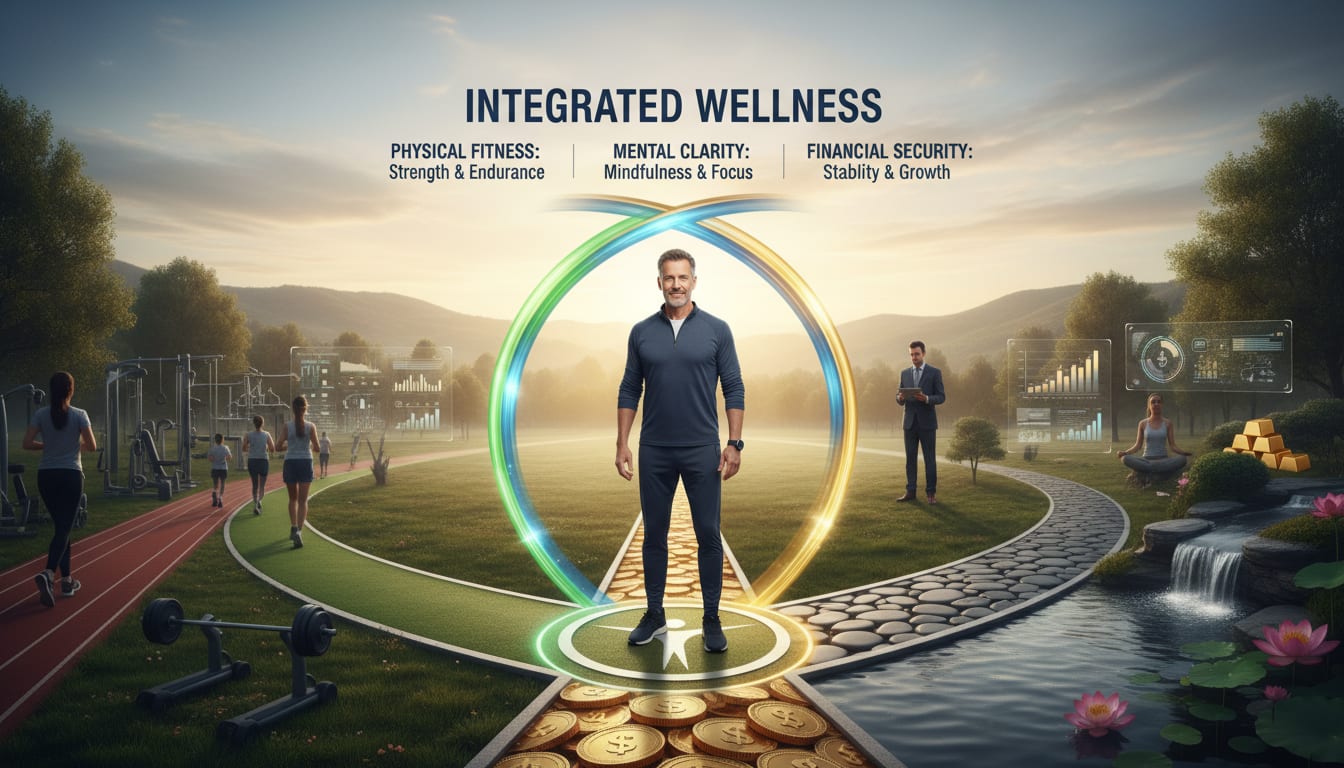
In this comprehensive guide, we’ll explore how to design a holistic learning framework that integrates the three essential pillars of mid-life success: physical wellness, mental resilience, and financial independence. By the end, you’ll have a clear blueprint for lifelong learning strategies that fit your busy schedule and accelerate your personal transformation.
The Three-Pillar Learning Framework
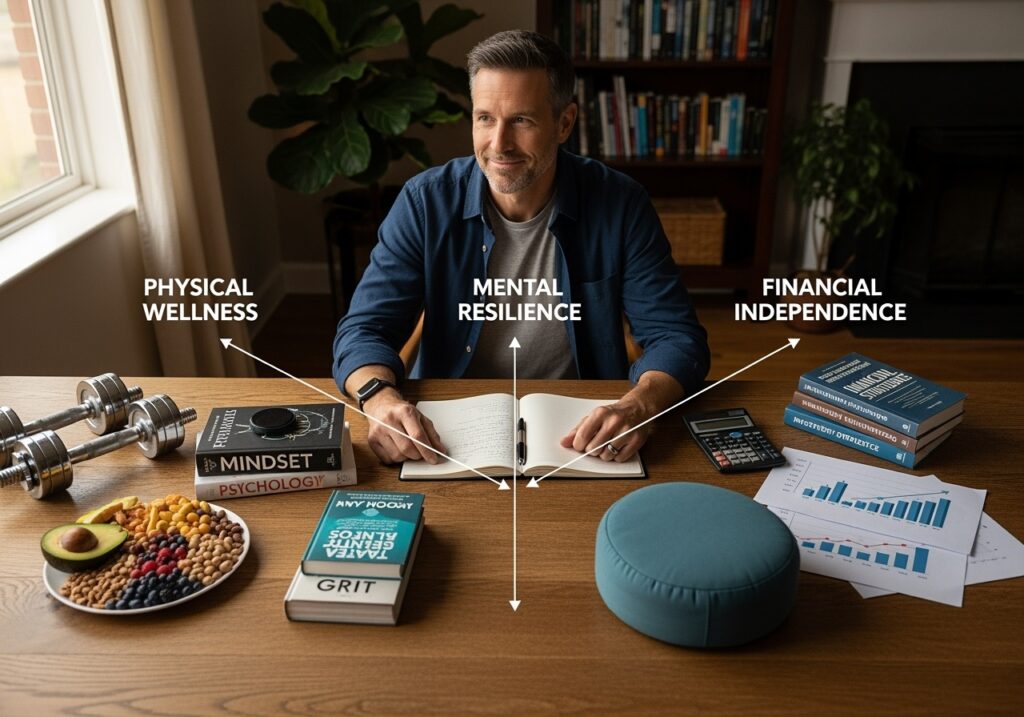
Your personal learning curriculum after 40 should address the interconnected areas that most impact your quality of life and long-term success. This is what we call The Triangle of Well-being: physical wellness, mental resilience, and financial independence.
Pillar 1: Physical Wellness Learning
Physical wellness isn’t just about exercise—it’s about understanding how your body works, what it needs to thrive, and how to maintain energy and vitality as you age. Your learning goals after 40 in this area might include:
Essential Learning Topics:
- Nutrition science simplified (understanding macronutrients, meal timing, and metabolic health)
- Movement patterns that protect joints and build functional strength
- Sleep optimization and recovery strategies
- Stress management through physical practices
- Preventive health and working effectively with healthcare providers
📚 Books from Amazon:
- “Atomic Habits” by James Clear – Perfect for building sustainable health routines ($15-18)
- “Why We Sleep” by Matthew Walker – Essential sleep science made accessible ($12-16)
- “The 4-Hour Body” by Tim Ferriss – Practical health optimization strategies ($14-18)
💻 Online Courses:
- Coursera’s “Introduction to Nutrition and Health” – Stanford University course, often free to audit
- MasterClass Subscription – Includes fitness and wellness classes from top experts ($180/year)
For those on tighter budgets, YouTube channels like “Athlean-X” and “Thomas DeLauer” offer excellent free content, while your local library likely has many health and wellness books available at no cost.
Note: Prices and availability may vary. Always check current pricing and read recent reviews before purchasing.
Pillar 2: Mental Resilience Learning
Mental resilience encompasses emotional intelligence, stress management, mindset work, and cognitive flexibility. This competency-based learning area is crucial for navigating mid-life challenges and maintaining psychological well-being.
Essential Learning Topics:
- Cognitive behavioral techniques for managing negative thought patterns
- Emotional regulation and stress response management
- Decision-making frameworks and problem-solving strategies
- Communication skills and conflict resolution
- Mindfulness and meditation practices
- Building confidence and overcoming imposter syndrome
📚 Books from Amazon:
- “Mindset” by Carol Dweck – Foundation for growth mindset development ($13-16)
- “The Power of Now” by Eckhart Tolle – Mindfulness and present-moment awareness ($12-15)
- “Emotional Intelligence 2.0” by Travis Bradberry – Practical EQ development ($14-17)
💻 Online Courses:
- Headspace Subscription – Guided meditation and mindfulness training ($70/year)
- Udemy’s Psychology and Mental Health courses – Often available for $10-50 during sales
This pillar connects directly to Building Unshakeable Confidence in Your 40s and Beyond, where we explore specific techniques for developing mental resilience.
Note: Prices and availability may vary. Always check current pricing and read recent reviews before purchasing.
Pillar 3: Financial Independence Learning
Financial literacy becomes increasingly critical after 40, as retirement planning, potential career changes, and family financial responsibilities intensify. Your professional development after 40 should include solid financial education.
Essential Learning Topics:
- Investment basics and portfolio management
- Tax optimization strategies
- Real estate and alternative investments
- Retirement planning and withdrawal strategies
- Side hustle development and multiple income streams
- Insurance and risk management
- Estate planning fundamentals
📚 Books from Amazon:
- “The Simple Path to Wealth” by JL Collins – Straightforward investing guide ($12-15)
- “Rich Dad Poor Dad” by Robert Kiyosaki – Financial mindset foundation ($8-12)
- “The Millionaire Next Door” by Thomas Stanley – Wealth-building principles ($13-16)
💻 Online Courses:
- Khan Academy’s Personal Finance Course – Comprehensive and completely free
- Coursera’s Financial Markets Course – Yale University, often free to audit
- Morningstar Investment Classroom – Free investment education
For deeper financial strategies, check out The Mid-Life Wealth Building Blueprint for a complete framework.
Note: Prices and availability may vary. Always check current pricing and read recent reviews before purchasing.
Designing Your Personalized Learning Curriculum

Now that you understand the three pillars, let’s create your structured self-improvement system. This learning pathway design process involves five key steps:
Step 1: Learning Assessment and Goal Setting
Before diving into new material, conduct an honest assessment of your current knowledge and skills in each pillar. This isn’t about judging yourself—it’s about creating a baseline so you can track progress and identify priority areas.
Simple Assessment Framework:
- Physical Wellness: Rate your current knowledge (1-10) in nutrition, exercise, sleep, and stress management
- Mental Resilience: Assess your skills in emotional regulation, communication, decision-making, and mindfulness
- Financial Independence: Evaluate your understanding of investing, budgeting, tax planning, and wealth building
Goal Setting Template
For each pillar, identify:
- One immediate goal (achievable in 30-60 days)
- One medium-term goal (3-6 months)
- One long-term goal (6-12 months)
Example: “In 60 days, I want to understand basic investment principles well enough to start a simple index fund portfolio. In 6 months, I want to have $5,000 invested and understand asset allocation. In 12 months, I want to have a complete investment strategy aligned with my retirement goals.”
Step 2: Resource Curation and Learning Methods
Not all learning methods work equally well for every person or situation. Your learning resource curation should match your learning style, schedule, and budget.
Learning Method Options
Visual Learners:
- Books and e-books
- Infographics and charts
- Video courses and documentaries
- Mind mapping and visual note-taking
Auditory Learners:
- Podcasts and audiobooks
- Online lectures and webinars
- Discussion groups and study partners
- Voice recording your own notes
Kinesthetic Learners:
- Hands-on workshops and classes
- Practical exercises and experiments
- Physical note-taking and journaling
- Real-world application projects
Budget-Conscious Options:
- Library books and digital resources
- Free online courses (Khan Academy, Coursera audit options)
- YouTube educational channels
- Podcast libraries
- Community college continuing education classes
Premium Options:
- MasterClass All-Access Pass – $180/year for unlimited access to expert-taught classes
- Audible Subscription – $15/month for audiobooks
- LinkedIn Learning – $30/month for professional development courses
Step 3: Creating Your Learning Schedule
The biggest challenge in adult learning curriculum development is consistency. Your schedule needs to be realistic and sustainable, not aspirational.
The 5-3-1 Learning Framework:
- 5 minutes daily: Quick learning (podcast during commute, reading one article)
- 30 minutes 3x per week: Focused study sessions
- 1 hour weekly: Deep dive or practical application
Sample Weekly Schedule:
- Monday: 30-minute financial education session
- Wednesday: 30-minute physical wellness learning
- Friday: 30-minute mental resilience practice
- Saturday: 1-hour practical application (trying new recipe, meditation practice, reviewing investments)
- Daily: 5-minute podcast or article during commute
Seasonal Learning Blocks: Consider organizing your learning into 90-day blocks, similar to The 90-Day Summer Challenge approach. This allows for deeper focus and measurable progress.
Step 4: Progress Tracking and Assessment
Knowledge acquisition strategies are only effective if you can measure progress and adjust course when needed. Your progress tracking methods should be simple but comprehensive.
Weekly Check-in Questions:
- What new concept did I learn this week?
- How did I apply new knowledge in real life?
- What challenged me, and how did I overcome it?
- What do I want to focus on next week?
Monthly Assessment:
- Review your three pillar goals
- Identify knowledge gaps that have emerged
- Adjust your learning plan based on what’s working
- Celebrate progress and milestones
Quarterly Deep Dive:
- Complete skill assessments in each pillar
- Update your learning goals based on life changes
- Evaluate and refresh your resource list
- Plan the next 90-day learning block
Step 5: Integration and Application
The most critical aspect of your personal learning curriculum after 40 is integration—connecting new knowledge across pillars and applying it in real-world situations.
Integration Strategies:
- Cross-Pillar Projects: For example, using stress management techniques (mental resilience) to improve sleep quality (physical wellness) which enhances decision-making for investments (financial independence)
- Teaching Others: Explaining concepts to family, friends, or colleagues solidifies your understanding
- Real-World Experiments: Testing new knowledge in low-risk situations
- Reflection Journaling: Regular writing about how new learning applies to your specific situation
This integration approach aligns perfectly with Creating Your Personal Success Ecosystem, where we explore how different life areas support each other.

Atomic Habits by James Clear breaks down how tiny mindset changes compound into major transformations. It's written in plain English—no psychology degree needed.
Overcoming Common Fall Fitness Challenges
Challenge 1
“I Don’t Have Time”
Reality Check: You don’t need hours of daily study time. The 5-3-1 framework requires just 2.5 hours per week—less time than most people spend watching Netflix.
Solutions:
- Use “dead time” for learning (commutes, waiting in lines, exercise time)
- Replace one entertainment activity with learning
- Batch learning activities (one focused session vs. scattered attempts)
- Use audio content during routine activities
Challenge 2
“I’m Too Old to Learn New Things”
Reality Check: Adult learning theory shows that while we may learn differently than teenagers, we often learn more effectively due to life experience and clearer motivation.
Solutions:
- Start with topics that build on existing knowledge
- Connect new learning to current challenges or interests
- Celebrate small wins and progress milestones
- Remember that expertise in any field takes time—be patient with yourself
Challenge 3
“Information Overload”
Reality Check: The internet offers unlimited information, but not all of it is relevant or accurate for your situation.
Solutions:
- Stick to your curated resource list
- Focus on one pillar at a time for deeper learning
- Seek recommendations from trusted sources
- Quality over quantity—better to master one book than skim ten
Challenge 4
“I Can’t Afford Expensive Courses”
Reality Check: Some of the best learning resources are free or low-cost. Your local library, YouTube, and free online courses offer university-level education at no cost.
Budget-Friendly Solutions:
- Start with free resources and upgrade only when you’ve established consistent learning habits
- Look for sales and discounts on premium platforms
- Share subscriptions with family members where allowed
- Invest in one quality resource per quarter rather than buying everything at once
📱 Apps and Digital Tools:
- Kindle Unlimited – $10/month for unlimited e-book access
- Blinkist – $8/month for book summaries (great for busy schedules)
- Skillshare – $8/month for creative and business skills
Note: Prices and availability may vary. Always check current pricing and read recent reviews before purchasing.
Creating Accountability and Community
Self-directed learning curriculum success dramatically improves with accountability and community support. Here are strategies that work particularly well for adults over 40:
Learning Partners and Study Groups
Find someone with similar learning goals and commit to regular check-ins.
This could be:
- A spouse or partner working on complementary skills
- A colleague interested in professional development
- An online community focused on your learning topics
- A local meetup group for adult learners
Professional Development Integration
If you’re employed, explore how your personal learning can align with professional development opportunities:
- Request training budget for courses that benefit both you and your employer
- Join professional associations in your field
- Attend conferences and workshops
- Seek mentorship from colleagues with expertise in your learning areas
Family Integration
Include family members in appropriate learning activities:
- Cook healthy meals together while learning nutrition principles
- Practice stress management techniques as a family
- Discuss financial goals and planning as a couple
- Share interesting concepts from your reading
This approach connects to The Triangle of Well-being philosophy that all life areas are interconnected.

Flip 7 Caramel Macchiato Crush Shake – Feel better, fast with one shake a day. FLIP 7 is an unmatched, all-in-one meal replacement SUPERFOOD powder with the most nutrient rich balance of health extending blends formulated to support whole body and mind wellness.
Seasonal Learning Adjustments
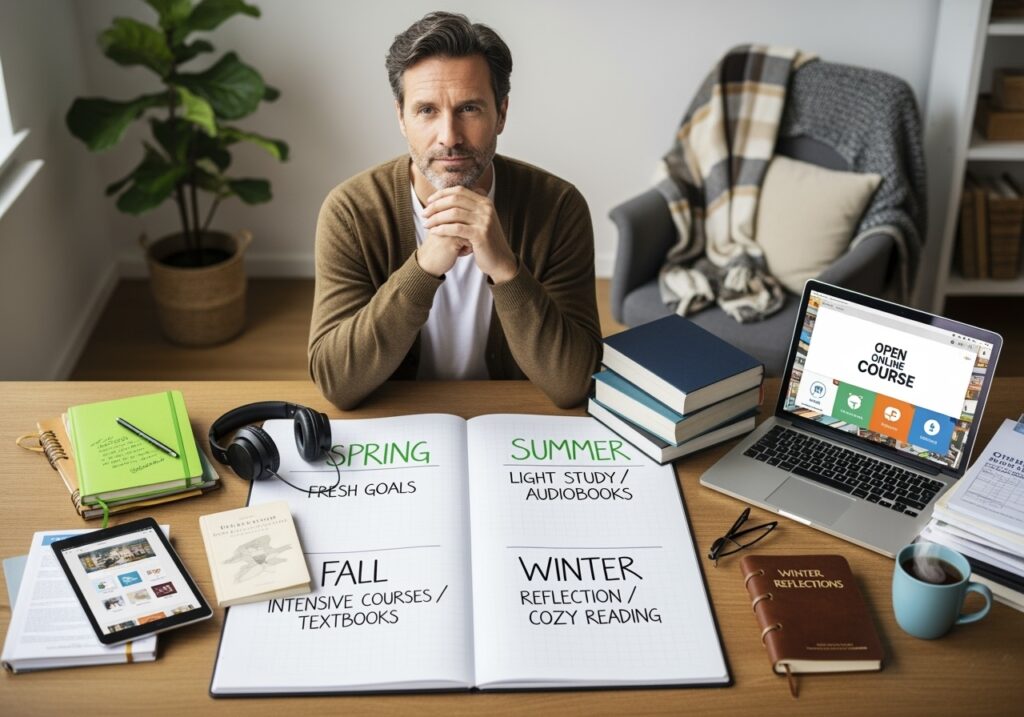
Your learning goals after 40 should adapt to natural life rhythms and seasonal changes.
Here’s how to optimize your curriculum throughout the year:
Spring: New Beginnings and Goal Setting
- Focus on educational goal setting and curriculum planning
- Emphasize physical wellness as weather improves
- Start new learning challenges and skill development
- Perfect time for The Over-40 Body Reset integration
Summer: Maintenance and Integration
- Lighter learning load to accommodate vacations and family time
- Focus on knowledge integration and practical application
- Outdoor learning opportunities (walking meetings, audiobooks during exercise)
- Connect with Summer Optimization Plan strategies
Fall: Intensive Learning and Skill Building
- Peak learning season with renewed focus after summer
- Intensive courses and certification programs
- Professional development after 40 planning for the following year
- Financial planning and tax preparation education
Winter: Reflection and Deep Study
- Longer indoor time perfect for reading and online courses
- Reflection on the year’s learning progress
- Planning next year’s personal learning curriculum after 40
- Mental resilience focus during potentially challenging season
Creating Learning Rituals and Habits
Habit formation is crucial for maintaining your self-directed learning curriculum. Here are proven strategies for making learning automatic:
The Learning Stack Method
Attach new learning habits to existing routines:
- Coffee + 10 minutes of reading
- Commute + educational podcast
- Lunch break + online course module
- Evening walk + audiobook
- Weekend morning + skill practice
Environmental Design
Set up your physical environment to support learning:
- Dedicated learning space (even just a corner of a room)
- Books and materials easily accessible
- Technology charged and ready
- Distractions minimized during learning time
The 2-Minute Rule
If a learning activity takes less than 2 minutes, do it immediately:
- Read one article
- Watch one educational video
- Review flashcards
- Listen to one podcast segment
- Write one journal entry
- “Atomic Habits” by James Clear – The definitive guide to habit formation ($15-18)
- Habitica App – Gamify your learning habits (free with premium options)
- “The Power of Habit” by Charles Duhigg – Understanding the psychology of habits ($14-17)
Note: Prices and availability may vary. Always check current pricing and read recent reviews before purchasing.
Conclusion: Your Learning Legacy

Creating a personal learning curriculum after 40 isn’t just about acquiring new skills—it’s about modeling lifelong growth for your family, contributing meaningfully to your community, and ensuring you remain adaptable and relevant in a rapidly changing world.
“Live as if you were to die tomorrow. Learn as if you were to live forever.”
– Mahatma Gandhi
Your holistic learning framework across physical wellness, mental resilience, and financial independence creates a foundation not just for personal success, but for becoming the kind of person others look to for wisdom and guidance. This is perhaps the greatest return on your learning investment: the ability to positively impact others through your own growth and development.
Remember, this isn’t about perfection or comparing yourself to others. It’s about consistent progress, practical application, and the deep satisfaction that comes from knowing you’re actively creating the life you want rather than simply reacting to circumstances.
Your Next Steps:
- This Week: Complete the three-pillar assessment and set your first 30-day learning goal
- This Month: Establish your learning schedule and acquire your first set of resources
- This Quarter: Build consistent habits and track your progress
- This Year: Experience the compound effects of consistent learning across all three pillars
The journey of lifelong learning strategies after 40 isn’t always easy, but it’s always worth it. Every book you read, every skill you develop, and every insight you gain makes you more capable, confident, and prepared for whatever comes next.
As you embark on this learning journey, remember that the best time to plant a tree was 20 years ago—the second best time is now. Your future self will thank you for the investment you make in learning today.
Disclosure
This article contains affiliate links. If you choose to make a purchase through these links, we may earn a commission at no additional cost to you.
Important Note: The information in this post is meant to educate and inform, not to replace professional mental health care or psychological advice. While we’ve spent years studying mental resilience and personal development, we’re not licensed mental health professionals or therapists. Everyone’s life circumstances and mental health journey are unique, so what works for one person might not work for another. If you’re experiencing serious mental health challenges, please reach out to a qualified mental health professional. Some of the strategies discussed may not be suitable for everyone, and it’s important to assess your own situation carefully. By reading and using this information, you’re taking responsibility for your own decisions. Remember, seeking help is a sign of strength, not weakness. Stay resilient!