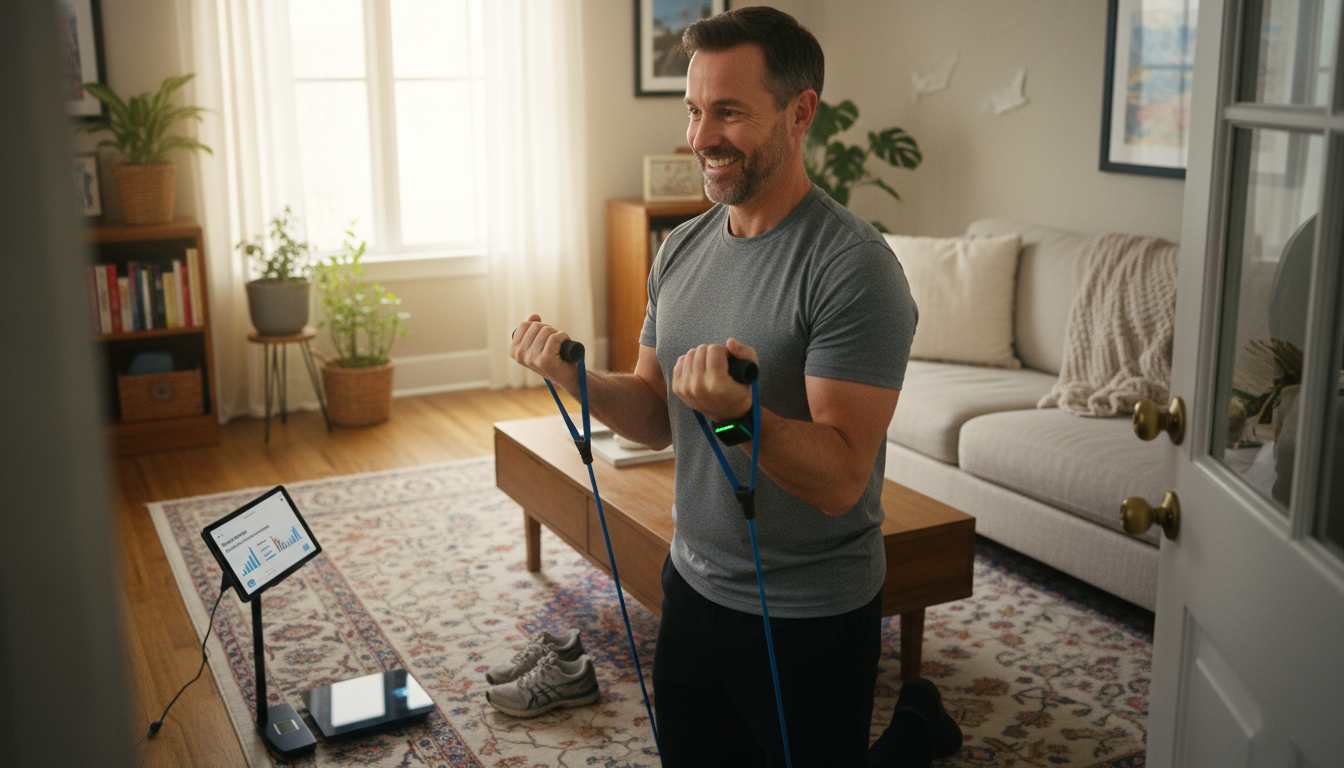
Life Optimization: Creating Synergy Between Work and Wellness
Ever feel like you’re running on empty by Wednesday? You’re crushing it at work, but your health is taking a backseat. Or maybe you’re trying to stay fit, but your career feels like it’s stalling out.
Here’s what most guys don’t realize: work and wellness aren’t enemies fighting for your time—they’re actually teammates that can help each other win. Think of it like a car that runs on two types of fuel. When both tanks are full, you go further and faster than you ever could on just one.
“The key is not to prioritize what’s on your schedule, but to schedule your priorities.”
— Stephen Covey
This isn’t about finding some mythical “perfect balance” where everything gets equal time. It’s about making smart choices that boost both your career and your health at the same time. Many men in their 40s and 50s struggle with this exact challenge—feeling stuck between career demands and health goals. If this sounds familiar, you’re not alone.
Disclosure
This article contains affiliate links. If you choose to make a purchase through these links, we may earn a commission at no additional cost to you.
How Work and Wellness Can Help Each Other
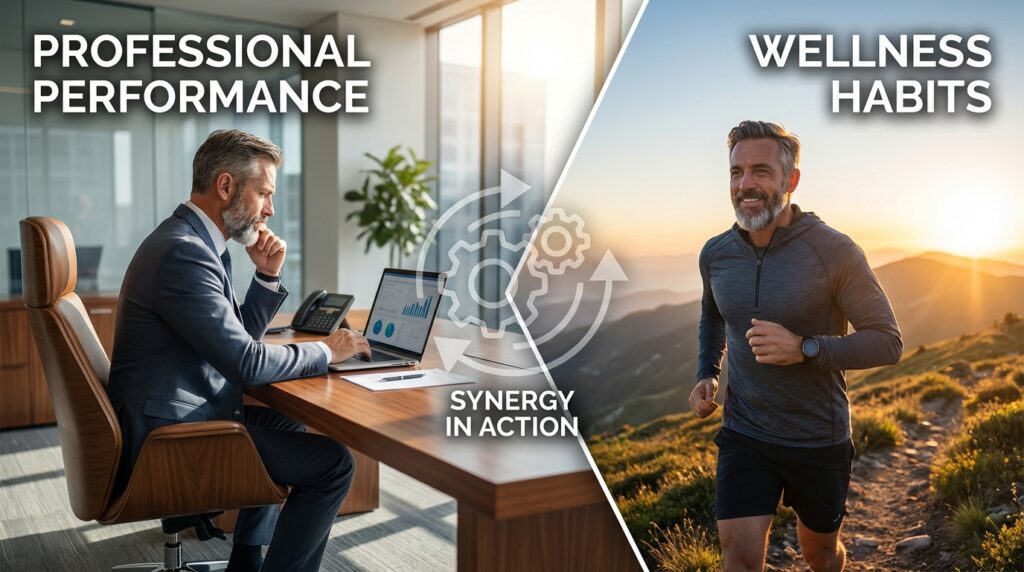
Synergy is just a fancy word that means “working together to get better results.” Like when you eat a healthy breakfast—it gives you energy for your morning meeting AND keeps your metabolism running strong. That’s synergy: one action helping two different goals.
Think of it like a well-tuned car engine—when all parts work together efficiently, you get better performance and longer-lasting results. Your wellness habits actually boost your work performance, while your professional skills can enhance your health journey.
For a complete framework on integrating all three pillars of wellness, explore The Triangle of Well-being: How Health, Mind, and Money Connect.
The Four Pillars of Work-Wellness Integration
1. Strategic Time Management for Busy Professionals

Time management isn’t about cramming more into your day—it’s about making intentional choices that serve both your career and your health.
Time management becomes even more critical when you’re dealing with decision fatigue from a demanding job.
The 80/20 Energy Rule
Focus 80% of your effort on the 20% of activities that produce the biggest results. This applies to both work projects and health habits. For example, a 20-minute morning workout might give you 80% of the energy boost you’d get from an hour-long gym session.
Time-Blocking for Wellness
Whether you’re a corporate executive with a flexible schedule or working hourly shifts with set break times, time-blocking works for everyone:
- If you have schedule flexibility: Block 6:30-7:00 AM for morning movement before your day starts
- If you work fixed shifts: Use your lunch break—even 10 minutes of walking counts
- If you work from home: Set phone alarms for 2-minute stretch breaks between tasks
- If you’re on the road: Park farther away, take stairs, do desk exercises during calls
Practical Example: Instead of checking emails first thing in the morning, start with 15 minutes of movement. Your brain will be sharper for that important morning meeting, and you’ve already invested in your health.
A quality programmable timer watch can help you stay on track with time-blocking throughout your day, with multiple alarms for wellness reminders.
2. Smart Energy Allocation Strategies

Your energy is like a bank account—you need to be strategic about deposits and withdrawals. Think of this as checking your personal “battery levels” throughout the day.
Just like your phone battery drains faster with certain apps, your energy drops faster with certain tasks.
The Energy Audit Process
Step 1: Track your energy levels hourly for one week
Use a simple 1-10 scale in a notebook or your phone. Notice patterns—when do you feel most alert? When do you crash?
Step 2: Align tasks with energy levels
Schedule your most demanding work during peak energy hours. Save routine tasks for low-energy periods. Plan workouts when your energy naturally rises.
Step 3: Build energy-boosting habits
Your energy levels are directly connected to what you eat. For a deeper dive into fueling your body right, check out Nutrition Basics: Eating for Energy and Health.
Proper hydration is crucial—it can boost cognitive performance by up to 12%. Consider investing in a quality water bottle with time markers to track hydration throughout your workday:
- Budget-friendly ($10-15): Basic 32oz water bottle from Nalgene—add your own time markers with a Sharpie
- Mid-range ($20-30): Motivational water bottle with time markers and inspirational quotes
- Investment ($40+): Insulated smart bottle that keeps water cold all day

ST-YIBEN 64Ooz Large Motivational Water Bottle with Time Marker
3. Priority Setting Frameworks That Work
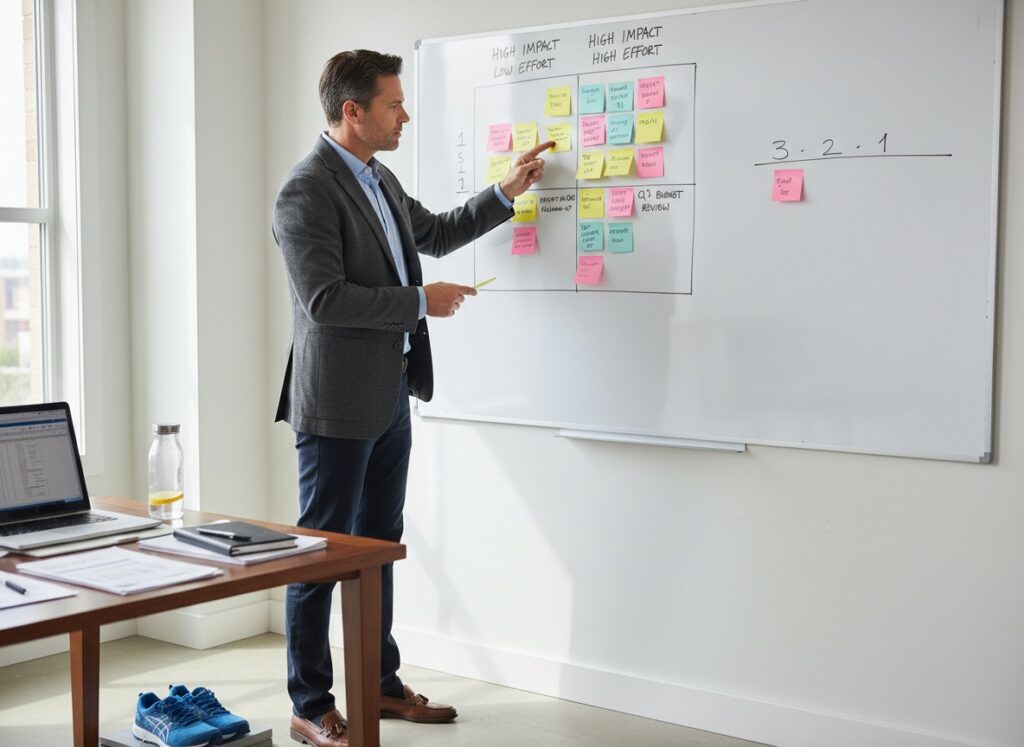
When everything feels urgent, nothing truly is. Here’s how to cut through the noise and focus on what actually moves the needle for both your career and health.
The ICE Method (Impact, Confidence, Ease)
The ICE Method is a simple scoring system that helps you figure out what to tackle first. ICE stands for Impact (how much difference will this make?), Confidence (how sure are you that you can do it?), and Ease (how simple is it to start?).
For each task or goal, rate it 1-10 on:
- Impact: How much will this improve your life?
- Confidence: How certain are you that you can complete it?
- Ease: How simple is it to start?
Multiply the scores. Higher numbers = higher priority.
Example: Morning workout scores: Impact (8) × Confidence (7) × Ease (6) = 336. Checking social media scores: Impact (2) × Confidence (10) × Ease (10) = 200. The workout wins.
The 3-2-1 Daily Framework
- 3 work priorities that move your career forward
- 2 wellness actions (one physical, one mental)
- 1 personal connection (family, friend, or self-reflection)
Keep a daily planner specifically designed for goal-setting and habit tracking to maintain this framework consistently.
Weekly Priority Alignment
Every Sunday, spend 15 minutes asking:
- What are my top 3 career goals this week?
- What are my top 3 health goals this week?
- Where do they overlap? (This is your synergy zone)

Panda Planner Pro Daily Planner
Track your progress with the Panda Planner on Amazon, designed specifically for goal-setting and mindset work.
4. Success Metrics That Matter
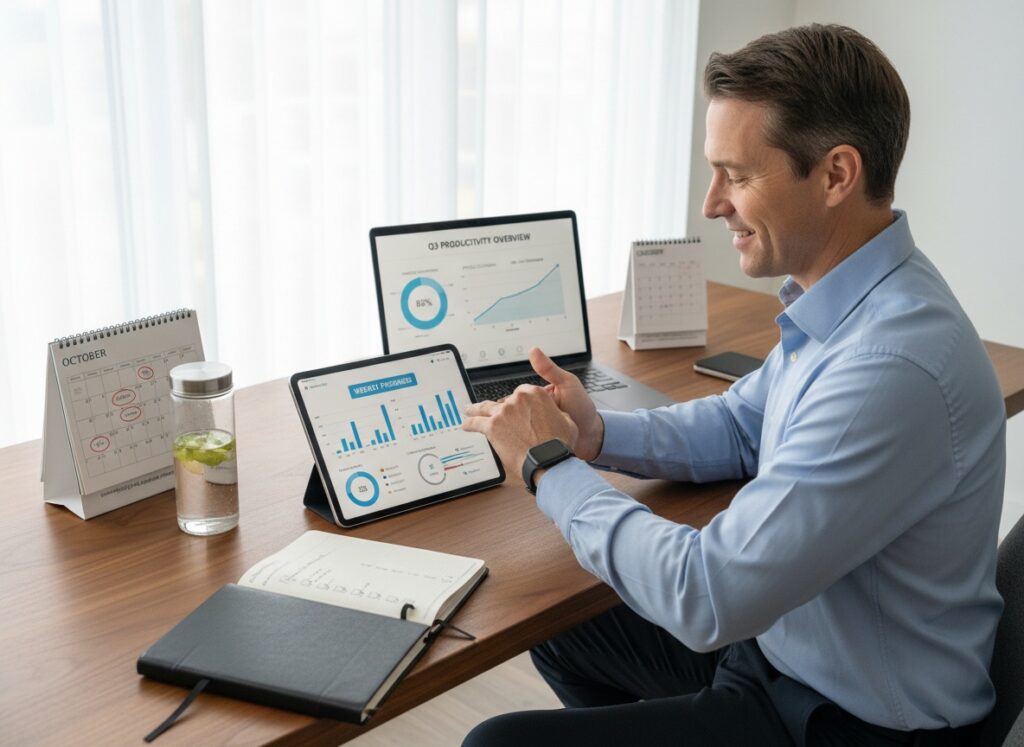
What gets measured gets managed. But measuring the wrong things can derail your progress.
Here’s what to track for real work-wellness integration.
Professional Metrics
- Energy levels during key meetings (1-10 scale)
- Decision quality (how confident you feel about choices)
- Project completion rate (not just hours worked)
- Creative problem-solving moments (track when breakthroughs happen)
Wellness Metrics
- Consistent movement days per week (not perfection, consistency)
- Sleep quality (how rested you feel, not just hours)
- Stress recovery time (how quickly you bounce back)
- Nutrition wins (healthy choices made, not calories counted)
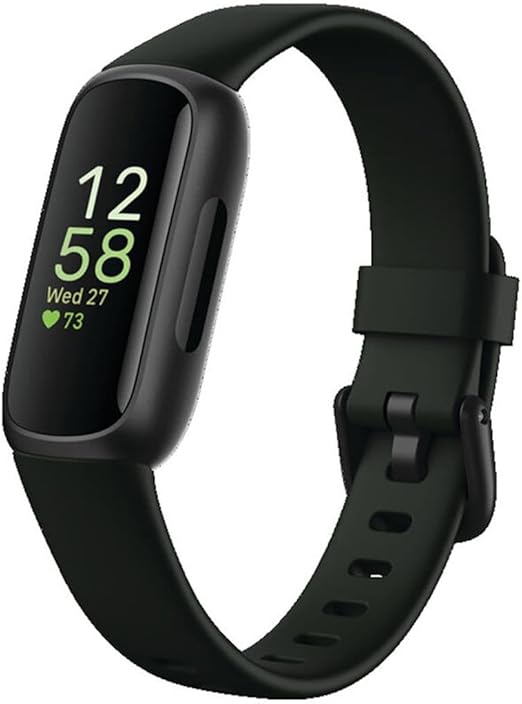
A fitness tracker designed for men over 40 can help you monitor these wellness metrics without overwhelming you with data. For more guidance, check out our comprehensive fitness tracker guide.
Integration Metrics
- Days you accomplished both work and wellness goals
- Energy improvement correlation (better workouts = better work days?)
- Stress levels trending (up or down over time?)
Understanding how your physical wellness impacts your professional performance is crucial. Learn more in Health & Wealth: How Physical Wellness Impacts Your Financial Future.
The 30-Day Work-Wellness Synergy Challenge
Ready to put this into practice? Here’s your step-by-step roadmap. This challenge pairs perfectly with our comprehensive approach to transformation in The 90-Day Summer Challenge: Transform Your Life by October.
Week 1: Foundation Building
Days 1-3: Track your current energy patterns hourly. No changes yet—just observe and record.
Days 4-7: Identify your peak energy window. Schedule one important work task and one 10-minute movement session during this time.

Week 2: Habit Integration
Days 8-10: Add a 5-minute morning routine before work (stretching, breathing, or light movement).
Days 11-14: Implement the 3-2-1 daily framework. Start each morning by writing down your 3 work priorities, 2 wellness actions, and 1 personal connection.

Keep a set of resistance bands at your desk for quick strength exercises during breaks. These work whether you're in an office or working from home.
Week 3: Optimization
Days 15-17: Use the ICE Method to prioritize your weekly tasks. Cut or delegate anything scoring below 100.
Days 18-21: Experiment with different workout times. Test morning, lunch, and evening sessions to find what energizes you most for work.

A basic yoga mat opens up home workout possibilities without gym membership costs.
Week 4: Sustainability
Days 22-25: Review your metrics. What’s working? What needs adjustment? Double down on wins, modify struggles.
Days 26-30: Create your personalized work-wellness routine based on what you’ve learned. Schedule it for the next 30 days.

Invest in quality meal prep containers to make healthy eating easier during busy work weeks. Proper nutrition is non-negotiable for sustained energy.
Overcoming Common Obstacles
“I don’t have time for wellness at work”
Solution: Start with 2-minute habits—desk stretches during calls, deep breathing between meetings, or stepping outside for fresh air. Small consistent actions compound over time. You’re not looking for perfection; you’re building momentum.
Quick win: Keep a foam roller under your desk for 2-minute muscle release sessions between tasks.
“My job is too demanding”
Solution: High-demand jobs actually require better wellness habits, not fewer. Your performance depends on your energy reserves. Think of wellness as career insurance—it protects your ability to perform when it matters most.
The most successful professionals understand this principle. Learn more in The 40+ Optimization Blueprint: Combining Health, Mind, and Wealth.
“I feel guilty taking breaks”
Solution: Reframe breaks as performance investments. Research shows a 10-minute walk can boost creativity and problem-solving for hours. You’re not being lazy—you’re optimizing your brain function.
Pro tip: A standing desk converter lets you alternate between sitting and standing throughout the day, reducing fatigue without taking time away from work.
“I can’t afford gym memberships or expensive equipment”
Solution: You don’t need a gym to get results. Bodyweight exercises, walking, and minimal equipment deliver excellent results:
- Free options: Walking, bodyweight exercises (push-ups, squats, planks), YouTube workout videos
- Under $50 total: Resistance bands, jump rope, and a yoga mat
- Under $150: Add adjustable dumbbells for a complete home gym


Making It Sustainable
The key to lasting work-wellness synergy isn’t perfection—it’s consistency and adaptation. Life will throw curveballs, deadlines will pile up, and some days wellness will take a backseat. That’s normal and okay.
What matters is getting back on track quickly and viewing setbacks as data, not failures. Each obstacle teaches you something about what works for your unique situation.
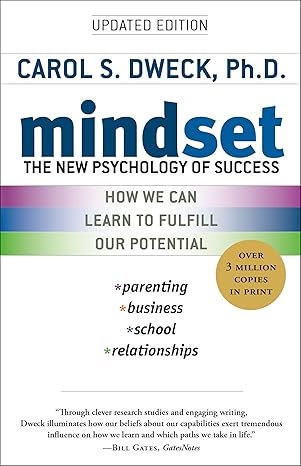
Mindset: The New Psychology of Success
Essential Resources for Long-Term Success
Books for Wisdom:
Atomic Habits by James Clear — The definitive guide to building sustainable habits that stick. Perfect for busy professionals who need practical systems, not motivation speeches.
Why We Sleep by Matthew Walker — Understanding sleep’s impact on work performance and health is game-changing. This book will transform how you prioritize rest.
Deep Work by Cal Newport — Learn to maximize productivity in less time, creating space for wellness without sacrificing career growth.
Tools for Health:
- Resistance bands set for strength training anywhere
- Meal prep containers for nutrition consistency
- Foam roller for recovery and mobility
- Bluetooth headphones for walking meetings and workout motivation
Apps for Tracking:
- Audible for learning during commutes or workouts
- MyFitnessPal (free) for nutrition tracking
- Headspace or Calm (free versions available) for stress management
- Google Calendar for time-blocking wellness into your schedule
Frequently Asked Questions
Final Thoughts

Your next step is simple: Choose one technique from this article and implement it tomorrow. Don’t try to overhaul everything at once. Small, consistent improvements create lasting transformation.
Maybe it’s starting your day with 10 minutes of movement before checking email. Maybe it’s using the ICE Method to prioritize this week’s tasks. Maybe it’s simply tracking your energy levels for the next seven days to understand your patterns.
“Take care of your body. It’s the only place you have to live.”
— Jim Rohn
Whatever you choose, remember this: you’re not just building a career—you’re building a life. And the most successful professionals understand that sustainable performance requires taking care of the person behind the performance.
Work and wellness aren’t competing priorities. They’re two sides of the same coin, and when you integrate them strategically, both areas of your life improve simultaneously.
Ready to dive deeper into balancing all three pillars of your life? Explore our complete guide: Balance Fitness, Mindset & Money at 40: Your Simple Guide.
Disclosure
This article contains affiliate links. If you choose to make a purchase through these links, we may earn a commission at no additional cost to you.
Important note: The information provided in this post is for educational and informational purposes only. While we’ve spent over a decade studying health, wellness, and financial strategies, we are not a licensed healthcare provider, mental health professional, or financial advisor. Everyone’s situation is unique, so what works for one person might not work for another. For physical health matters, always consult your doctor before starting any new fitness program. For mental health concerns, please seek qualified mental health professionals. For financial decisions, consult with certified financial advisors who can assess your specific situation. The content here reflects personal research and experience but shouldn’t replace professional advice in any of these areas. By reading and using this information, you’re taking responsibility for your own decisions. Your health, mind, and money deserve professional guidance when needed. Stay awesome!