The Holistic Wellness Guide for Men Over 40: Connecting Health, Mindset, and Money
Ever feel like you’re spinning your wheels—working out but still stressed, making decent money but feeling exhausted, or trying to stay positive while your bank account says otherwise? You’re not alone. Most men over 40 struggle because they’re treating health, mindset, and finances as separate battles instead of one connected system.
“The greatest wealth is health, but true prosperity comes from balancing body, mind, and wallet.”
— Adapted from Virgil
Here’s the truth: holistic wellness for men over 40 isn’t about perfecting one area of your life. It’s about understanding how physical health, mental resilience, and financial stability work together like a three-legged stool. So if one leg is weak, the whole thing becomes unstable.
Let’s explore this integrated health approach and show you how small improvements in one area naturally create positive changes in the others.
Disclosure
This article contains affiliate links. If you choose to make a purchase through these links, we may earn a commission at no additional cost to you.
Understanding the Holistic Wellness Connection
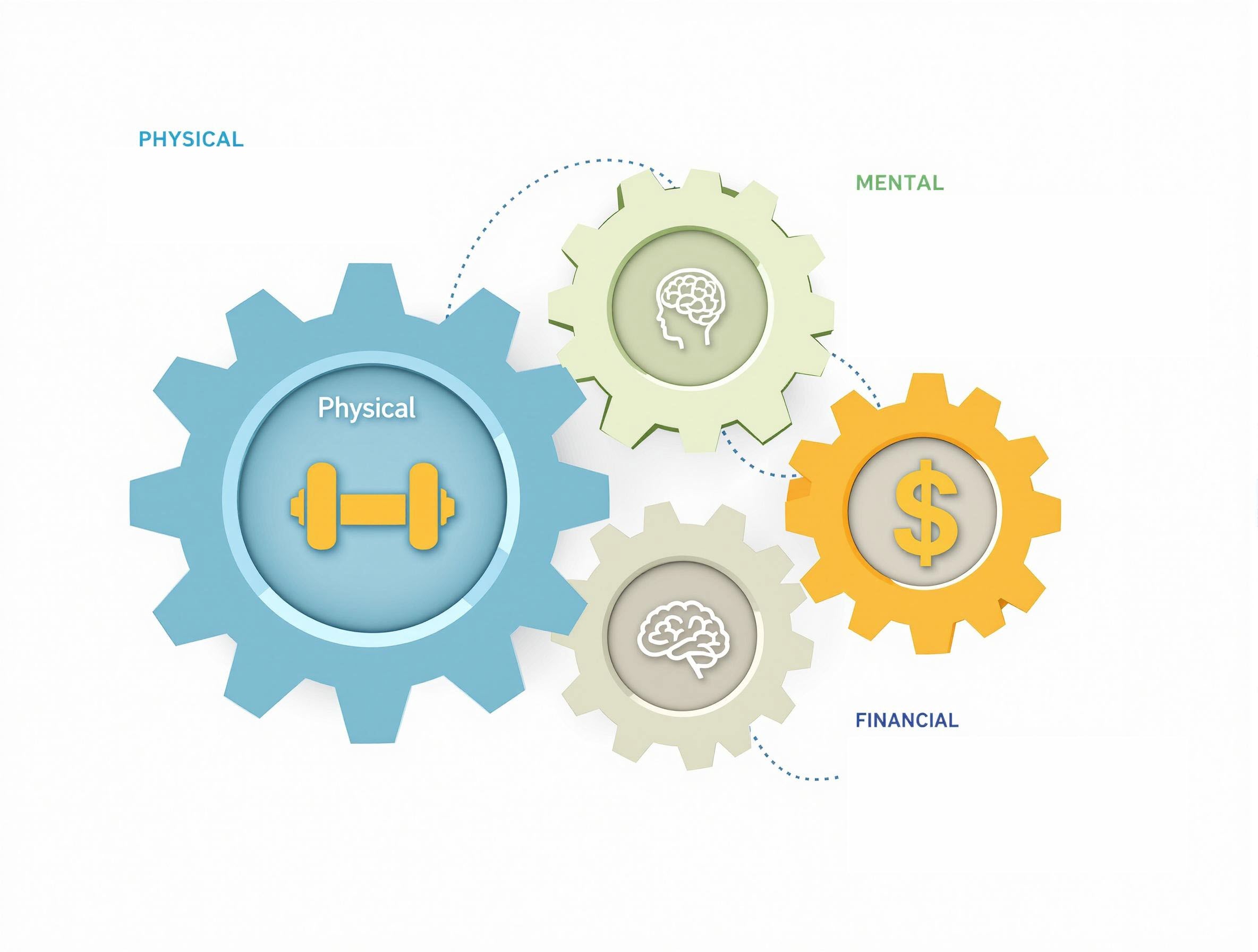
Think of your well-being like a three-legged stool. Each leg supports the others, and when one gets stronger, it makes the whole structure more stable. This mind-body-financial wellness connection is the foundation of lasting change after 40.
Here’s how these three pillars of holistic wellness work together:
Physical → Mental Connection
When you move your body, your brain releases chemicals called endorphins (think of them as your body’s natural “feel-good” medicine). A 20-minute walk can reduce anxiety by up to 25% for the next 2-4 hours. That’s cheaper and faster than any stress-relief app.
Real-world example: You wake up feeling overwhelmed about work. Instead of scrolling your phone, you do 15 minutes of stretching or a quick walk around the block. Suddenly, those problems don’t seem as big, and you can think more clearly about solutions.
Regular exercise also improves sleep quality, which means better focus and decision-making during the day. When you’re managing your energy levels effectively, everything else gets easier.
For all income levels:
- No budget? Walking costs nothing. Start with 10-minute walks after meals.
- Tight budget? Invest in resistance bands ($15-25) for home workouts. Check out these affordable resistance bands on Amazon that work just as well as expensive gym equipment.
- More flexibility? Consider a basic gym membership ($30-50/month) or home dumbbells. These adjustable dumbbells save space and grow with your strength.

FEIERDUN Adjustable Dumbbells
Learn more about sustainable fitness in our guide: The Over-40 Body Reset: A Guide to Sustainable Fitness
Mental → Financial Connection
Here’s something most guys don’t realize: your mindset directly impacts your wallet. Men who practice just 10 minutes of daily mindfulness make 15% fewer impulsive purchases. That could save you $100-300 per month without even trying.
What is mindfulness? Simply put, it’s paying attention to the present moment without judgment. Think of it like this: instead of buying that $80 gadget because you’re stressed, you pause, take three deep breaths, and ask yourself, “Do I really need this, or am I just feeling anxious?”
When you’re mentally clear and confident, you make better money decisions:
- You negotiate better salaries (because you know your worth)
- You avoid panic-selling investments during market dips
- You spot financial opportunities others miss
- You stick to budgets without feeling deprived
A stressed mind makes expensive mistakes. A calm, resilient mind builds wealth steadily. That’s why developing mental toughness is crucial—read more in our article on Mindset Mastery: Building Mental Toughness in Your Prime Years.

The Five Minute Journal
Financial → Physical Connection
Money stress is a silent health killer. Financial stress raises cortisol levels (your stress hormone) by 50%, which leads to:
- Weight gain around your midsection
- Disrupted sleep quality
- Higher blood pressure
- Weakened immune system
In plain English: When you’re worried about money, your body literally stores more belly fat and makes it harder to sleep. Fixing your money stress helps you lose weight and feel better—no extra gym time required.
On the flip side, having financial stability means you can afford:
- Quality food instead of cheap fast food
- A gym membership or home equipment
- Better healthcare and preventive checkups
- Time off to recover when you’re sick
Real-Life Success Story:
Meet Tom, age 47, who discovered this connection firsthand. “When I started morning walks, I had more energy for work, which led to a promotion. The extra income helped me invest in better food and a home gym, creating a positive cycle of improvement. I lost 20 pounds, got a raise, and sleep better than I have in years—all because I started with one 15-minute walk.”
For more on balancing all three areas, check out: Balance Fitness, Mindset & Money at 40: Your Simple Guide
Learn more about this integrated approach in our cornerstone article: The Triangle of Well-being: How Health, Mind, and Money Connect
Quick Self-Assessment: Which Leg of Your Stool is Weakest?
Before we dive into solutions, let’s figure out where you are right now.
Rate yourself honestly from 1-10 in each area:
Mental Resilience:
- Stress management
- Confidence in decisions
- Mental clarity and focus
- Emotional stability
Financial Stability:
- Income consistency
- Savings and emergency fund
- Money-related stress levels
- Financial planning and goals
Physical Wellness:
- Energy levels throughout the day
- Quality of sleep
- Fitness and mobility
- Overall health
Your lowest score? That’s where to start. But here’s the good news—improving that one area will naturally boost the other two. That’s the power of holistic wellness for men over 40.
How Physical Health Impacts Your Mental and Financial Success
Now that you understand the connections, let’s get practical. Here’s how to use these connections to your advantage:

Start Small, Win Big
The biggest mistake men make? Trying to overhaul everything on Monday. Don’t do that. Instead, pick ONE small action in your weakest area and do it consistently for two weeks.
Physical starter moves:
- 10-minute morning walk (no equipment needed)
- 10 push-ups against your kitchen counter (easier than floor push-ups)
- Drink one extra glass of water with each meal
Mental starter moves:
- 5 minutes of deep breathing before bed
- Write down 3 things you’re grateful for each morning
- Turn off phone notifications for 1 hour daily
Financial starter moves:
- Track every dollar you spend for one week (use your phone’s notes app)
- Set up automatic savings of $25/week (even $10 works)
- Review one monthly subscription and cancel if unused
Pro tip: Start with quick morning routines that take less than 15 minutes. Check out our Thanksgiving Day Workout: Quick Morning Routine Before the Feast for ideas you can use any day of the year.
Learn more about sustainable fitness in The Over-40 Body Reset: A Guide to Sustainable Fitness
Build Your Integrated Wellness System
Once you’ve got one small habit down, it’s time to connect the dots. Here’s how to build habits that strengthen all three areas simultaneously:
Morning Routine (15-20 minutes):
- Physical: 10-minute walk or stretching
- Mental: 5 minutes of quiet reflection or gratitude journaling
- Financial: Check your bank balance and review yesterday’s spending (2 minutes)
Why this works: You’re training your brain to see these three areas as connected, not separate. Plus, morning wins create momentum for the whole day.
Evening Routine (10 minutes):
- Physical: Light stretching or mobility work
- Mental: Write down tomorrow’s top 3 priorities
- Financial: Update your spending tracker
For a complete weekly planning system, read: The Sunday Reset: A Simple Weekly Planning Routine for Busy Men
For more on building mental strength, see our article on Mindset Mastery: Building Mental Toughness in Your Prime Years

Habit Tracker Journal
Use the Wellness Synergy Effect
What is synergy? It means when things work better together than separately—like how peanut butter and jelly taste better as a sandwich than alone.
Here’s how to use this wellness synergy in real life:
Synergy Strategy #1: Exercise for Financial Clarity
Before making any purchase over $100, go for a 20-minute walk first. The physical movement clears your mind, reduces impulsive urges, and helps you think rationally about whether you really need it.
Synergy Strategy #2: Financial Wins for Physical Motivation
Every time you hit a financial milestone (paid off a credit card, saved $500, got a raise), invest a small portion in your physical health. Buy those quality running shoes, upgrade your home gym, or book that physical therapy session you’ve been putting off.
Budget-friendly options:
- $20-50: Quality water bottle, foam roller, or workout mat
- $50-100: Resistance bands set, yoga blocks, or fitness tracker
- $100-200: Running shoes, adjustable dumbbells, or meal prep containers

Aquasana’s fast-flowing Clean Water Machine removes 78 contaminants including 99% of lead & cysts, 15x more than the leading pitcher filter.
Synergy Strategy #3: Mental Health for Better Sleep (Which Improves Everything)
Quality sleep is the ultimate holistic wellness multiplier. When you sleep well, you have more energy for exercise, better focus for work (which leads to more income), and improved emotional control.
Sleep optimization on any budget:
- Free: Consistent sleep schedule (same bedtime every night)
- Low-cost: Blackout curtains or a sleep mask like this comfortable sleep mask
- Investment: Quality pillow or mattress topper (your neck and back will thank you)
Creating multiple income streams while optimizing your current career path can provide both security and growth opportunities. Explore financial opportunities in Creating Multiple Income Streams After 40.
Common Mistakes Men Make (And How to Avoid Them)
Let’s talk about what NOT to do. These mistakes derail more guys than anything else:
Mistake #1: Trying to Fix Everything at Once
The trap: You decide on Sunday night to start working out daily, eating perfectly, meditating, and tracking every penny. By Wednesday, you’re overwhelmed and quit everything.
The fix: Pick ONE area to focus on this week. Next week, add ONE small change in another area. Slow progress beats no progress every single time.
Example: Week 1 – Add a 10-minute morning walk. Week 2 – Keep the walk, add 5 minutes of journaling. Week 3 – Keep both, start tracking your spending. By week 4, you’ve built three habits instead of burning out on day 3.
Mistake #2: Comparing Your Chapter 1 to Someone Else’s Chapter 20
The trap: That guy on Instagram with six-pack abs, a Tesla, and perfect mental health? He’s been at this for years. You see his highlight reel and feel like a failure before you even start.
The fix: Your journey is your own. Compare yourself to where YOU were last month, not to strangers on social media. Progress photos work—take a selfie today, then another in 30 days. The changes might surprise you.
Reality check: Most “overnight success” stories took 5-10 years of consistent work. You’re not behind; you’re just getting started.
Mistake #3: Waiting for the “Perfect Time”
The trap: “I’ll start when work slows down… when the kids are older… when I have more money… when I feel more motivated.”
The fix: There’s no perfect time. Your kids will always need something. Work will always be busy. You’ll never “feel like it” on a cold Monday morning. Start now with 15 minutes. That’s it.
Truth bomb: The best time to start was 10 years ago. The second-best time is right now, today, this morning.
For help with stepping outside your comfort zone, read: Breaking Your Comfort Zone After 45: Simple Steps to Embrace Change


Your Personal Wellness Optimization Plan
Ready to put this into action? Here’s your step-by-step plan for building holistic wellness:
Week 1-2: Foundation Building
Goal: Establish one small habit in your weakest area
Action steps:
- Review your self-assessment scores from earlier
- Choose your weakest area (physical, mental, or financial)
- Pick ONE tiny habit from the “Start Small, Win Big” section
- Do it every day for 14 days straight
- Track it (checkmark on a calendar works great)
Success metric: 12 out of 14 days completed = you’re ready for week 3
Week 3-4: Connection Building
Goal: Add a second habit that connects to your first one
Action steps:
- Keep your first habit going (it should feel easier now)
- Add ONE habit from a different pillar
- Notice how they affect each other
- Journal about the connections you’re seeing
Example: If you started with morning walks (physical), add 5 minutes of gratitude journaling (mental) right after your walk. You’ll notice the walk makes the journaling easier, and the journaling makes you appreciate the walk more.
Week 5-8: System Integration
Goal: Build a complete morning or evening routine
Action steps:
- Combine 2-3 small habits into a 15-20 minute routine
- Do it at the same time every day (consistency is key)
- Track your energy, mood, and productivity
- Adjust based on what’s working
Weekly check-in questions:
- Which habit feels easiest now?
- Where am I seeing unexpected benefits?
- What’s one small adjustment I could make?
For a complete system approach, read: Energy Management for Men Over 40: Master Your Life
Month 3+: Expansion and Optimization
Goal: Deepen your practice and expand to new areas
Action steps:
- Increase intensity or duration of existing habits
- Add new habits in areas you haven’t addressed yet
- Start teaching others what you’ve learned (this solidifies your own understanding)
- Invest in tools or resources that support your progress
Investment priorities by income level:
Tight budget ($0-50/month):
- Quality water bottle and meal prep containers
- Basic resistance bands
- Free apps for tracking (MyFitnessPal, Mint, Headspace free trial)
- Library books on wellness topics
Moderate budget ($50-150/month):
- Gym membership or home workout equipment
- Meal delivery service (1-2 times/week to learn healthy cooking)
- Budgeting app subscription (YNAB or similar)
- Wellness journal and habit tracker
Flexible budget ($150+/month):
- Personal trainer (even just 2 sessions/month for guidance)
- Therapy or coaching
- Financial advisor consultation
- Quality supplements (after consulting your doctor)

Atomic Habits: An Easy & Proven Way to Build Good Habits & Break Bad Ones

The Psychology of Money: Timeless lessons on wealth, greed, and happiness
Holiday Wellness: Staying Strong During Stressful Times

With the holidays approaching, this integrated approach becomes even more critical.
Holiday stress affects all three areas—overeating (physical), family tension (mental), and overspending (financial). By strengthening your wellness triangle now, you’ll navigate the holidays with more confidence and less regret.
Holiday survival strategies:
Physical: Plan your workouts around holiday events, not instead of them. A 15-minute morning routine before Thanksgiving dinner keeps you grounded.
Mental: Set boundaries before family gatherings. It’s okay to say no to events that drain you.
Financial: Create a holiday spending budget BEFORE Black Friday. Stick to it by using cash or a prepaid card.
For more holiday strategies, read: Thanksgiving Success: Enjoying the Day Without Derailing Progress
And don’t forget your weekly financial check-ins: Sunday Financial Review: Weekly Money Check-In System
Final Thoughts

Remember: holistic wellness for men over 40 isn’t about perfection. It’s about understanding that your physical health, mental resilience, and financial stability are deeply connected. When you improve one area, you naturally create positive changes in the others.
“You don’t have to be great to start, but you have to start to be great.”
— Zig Ziglar
You don’t need to be perfect in all areas at once. Small improvements in one area naturally lead to benefits in others. Start where you are, with what you have, and let the positive effects multiply.
The integrated health approach we’ve covered today works because it’s based on how your body and mind actually function—not on unrealistic Instagram standards or get-rich-quick schemes.
Your Action Steps for Success
Today:
- Complete the self-assessment (rate yourself 1-10 in each area)
- Identify your weakest pillar
- Choose ONE small habit to start tomorrow morning
- Set a reminder on your phone
This Week:
- Do your chosen habit every single day
- Notice how it affects your energy and mood
- Track it with checkmarks on a calendar
- Celebrate small wins (seriously, this matters)
This Month:
- Add a second habit from a different pillar
- Start seeing the connections between areas
- Adjust based on what’s working for YOUR life
- Share your progress with someone (accountability helps)
This Quarter:
- Build a complete morning or evening routine
- Invest in tools that support your progress
- Help another guy who’s just starting out
- Review and celebrate how far you’ve come
Ready to Transform Your Life?
Struggling with where to start? Read our comprehensive cornerstone guide: The Triangle of Well-being: How Health, Mind, and Money Connect for an even deeper dive into this integrated approach.
Remember: The best time to start was 10 years ago. The second-best time is right now. You’ve got this.
Disclosure
This article contains affiliate links. If you choose to make a purchase through these links, we may earn a commission at no additional cost to you.
Important note: The information provided in this post is for educational and informational purposes only. While we’ve spent over a decade studying health, wellness, and financial strategies, we are not a licensed healthcare provider, mental health professional, or financial advisor. Everyone’s situation is unique, so what works for one person might not work for another. For physical health matters, always consult your doctor before starting any new fitness program. For mental health concerns, please seek qualified mental health professionals. For financial decisions, consult with certified financial advisors who can assess your specific situation. The content here reflects personal research and experience but shouldn’t replace professional advice in any of these areas. By reading and using this information, you’re taking responsibility for your own decisions. Your health, mind, and money deserve professional guidance when needed. Stay awesome!