Winter Bulk vs. Lean: Your December Fitness Strategy Guide
December is here, and if you’re scrolling through fitness advice online, you’ve probably seen two completely opposite messages: “Winter is bulking season—time to pack on muscle!” and “Stay lean year-round—don’t let the holidays derail you!”
So which one is right for you?
“The secret of getting ahead is getting started. The secret of getting started is breaking your complex overwhelming tasks into small manageable tasks, and then starting on the first one.”
– Mark Twain
Here’s the truth: both strategies can work for men over 40, but the right choice depends on your personal goals, lifestyle, and where you’re starting from. This isn’t about following what bodybuilders do or copying some influencer’s winter fitness goals. It’s about choosing a December fitness strategy that fits your real life.
Let’s break down what bulking and staying lean actually mean (without the gym jargon), help you decide which path makes sense for you, and give you practical, budget-friendly ways to make it happen.
Disclosure
This article contains affiliate links. If you choose to make a purchase through these links, we may earn a commission at no additional cost to you.
What Does “Bulking” and “Staying Lean” Actually Mean?
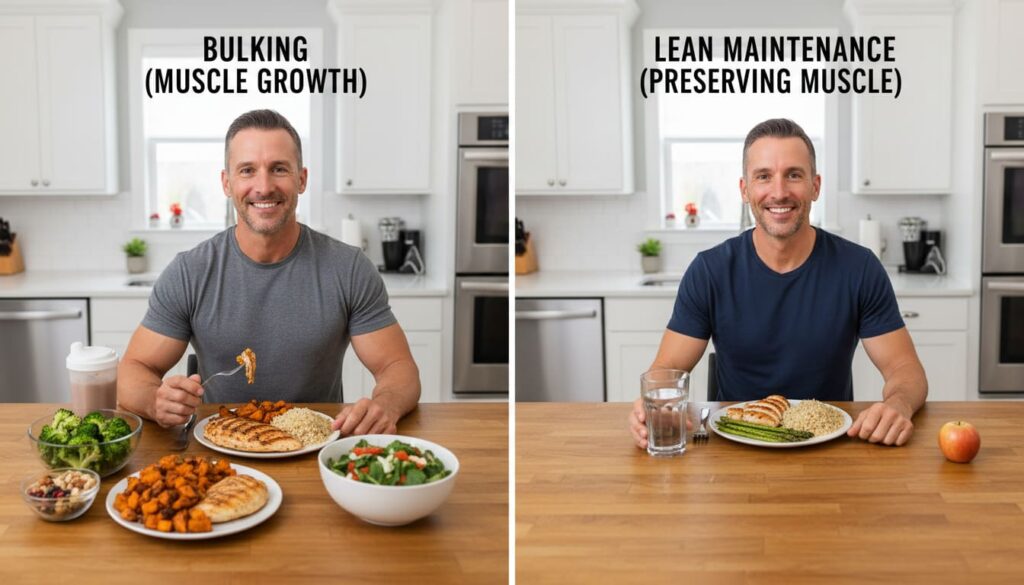
Before you can choose between winter bulk vs lean, you need to understand what these terms really mean—in plain English.
Bulking means eating more calories than your body burns each day to build muscle mass. Think of it like giving your body extra fuel and building materials. If your body normally needs 2,000 calories to maintain your current weight, bulking might mean eating 2,300-2,500 calories. That extra food—maybe a protein shake, an extra chicken breast, or a couple of peanut butter sandwiches—gives your muscles what they need to grow stronger when you’re lifting weights.
Staying lean means maintaining your current muscle while keeping body fat low. You’re eating roughly the same amount of calories your body burns (called maintenance calories), so your weight stays steady. You’re not trying to build significant new muscle, but you’re working hard to keep what you have and stay in good shape.
Here’s a simple comparison:
- Bulking = Building a new room onto your house (requires extra materials and work)
- Staying Lean = Maintaining your house in great condition (preserving what you have)
Both require effort. Both have value. Neither is “better” than the other—it depends on what you need right now.
Why Winter Makes Us Think About Bulking
There’s a reason bulking for men over 40 comes up every December. Winter naturally supports muscle-building for a few practical reasons:
You’re wearing more clothes anyway. Let’s be honest—when you’re in sweaters and jackets, a little extra body fat from eating more doesn’t show the same way it does in summer. This takes pressure off and lets you focus on getting stronger without worrying about your abs showing.
Your body wants more food in cold weather. Your appetite naturally increases when it’s cold outside. Instead of fighting this, bulking works with your body’s natural rhythms.
Holiday food is everywhere. Between Thanksgiving leftovers and Christmas dinners, December is filled with extra food. A winter fitness strategy that includes bulking lets you enjoy some of those meals without guilt, as long as you’re training hard.
You have time to build before summer. If you bulk from December through February, you have March through June to lean down before summer. That’s a solid timeline that many men over 40 find sustainable.
For a deeper dive into how your body changes after 40 and why timing matters, check out The Over-40 Body Reset.
The Reality of Bulking After 40
Here’s what most fitness content won’t tell you: bulking works differently when you’re over 40 than it does for guys in their twenties.
When you’re younger, your testosterone levels are higher, your metabolism is faster, and your body builds muscle more easily. You can eat a bigger surplus of calories and still build mostly muscle with minimal fat gain.
After 40, your body is more efficient at storing fat and less efficient at building muscle. This doesn’t mean you can’t bulk—it just means you need a smarter approach.
The smart bulk for men over 40:
- Smaller calorie surplus (200-300 extra calories, not 500-1000)
- Higher protein intake (your body needs more to build the same muscle)
- Consistent strength training (3-4 times per week minimum)
- Patience (muscle builds slower, but it still builds)
Real example: Instead of adding 500 calories of pizza and ice cream, you might add a protein shake with a banana (about 250 calories) and an extra serving of chicken at dinner (another 150 calories). That’s 400 quality calories that support muscle growth without excessive fat gain.

When Staying Lean Makes More Sense
Staying lean through winter isn’t about vanity or obsessing over six-pack abs. For many men over 40, it’s actually the smarter choice. Here’s when lean maintenance is your best December workout plan:
You’re already carrying extra body fat. If you’re honest with yourself and know you’re already 20-30 pounds above where you want to be, adding more weight—even muscle—isn’t the priority. Focus on maintaining muscle while slowly losing fat.
You have health concerns. High blood pressure, pre-diabetes, or joint issues? Your doctor probably wants you maintaining or losing weight, not bulking. Your health comes first, always.
You feel better lean. Some guys just feel more energetic, confident, and comfortable when they’re leaner. If that’s you, honor it. Mental well-being is part of The Triangle of Well-being—physical, mental, and financial health all matter.
You have an event coming up. Got a wedding, reunion, or vacation in January or February? Staying lean through December means you’ll look and feel your best without crash dieting.
You’re new to fitness. If you just started working out in the past 6-12 months, you can still build muscle while staying lean or even losing fat. This “newbie gains” window is real, so take advantage of it before committing to a bulk.

Flip 7 Peanut Butter Power - Feel better, fast with one shake a day. FLIP 7 is an unmatched, all-in-one meal replacement SUPER FOOD powder with the most nutrient rich balance of health extending blends formulated to support whole body and mind wellness.
Your Personal December Fitness Strategy Checklist
Stop guessing and use this simple decision framework. Answer these questions honestly:
Question 1: What’s your primary goal right now?
- Build significant muscle and strength → Lean toward bulking
- Maintain what you have and feel good → Lean toward staying lean
- Lose fat while keeping muscle → Definitely stay lean
Question 2: How do you feel about your current body?
- I’m relatively lean and want to build → Bulking makes sense
- I’m carrying extra fat I want to lose → Stay lean
- I’m somewhere in the middle → Either works; choose based on preference
Question 3: What’s your training consistency like?
- I lift weights 3-4+ times per week consistently → Bulking can work
- I’m inconsistent or just doing cardio → Stay lean until training is consistent
- I’m just starting out → Stay lean and build the habit first
Question 4: How’s your relationship with food?
- I can eat more without going overboard → Bulking is manageable
- I struggle with overeating or emotional eating → Stay lean; bulking might trigger issues
- I’m comfortable tracking portions → Either strategy works
Question 5: What does your lifestyle support?
- I have time to meal prep and train regularly → Either works
- My schedule is chaotic right now → Stay lean (simpler to maintain)
- I travel frequently for work → Stay lean (easier to manage)
Your decision: If you answered mostly in favor of bulking AND you’re training consistently, go for a strategic winter bulk. If you’re unsure or answered mostly toward staying lean, that’s your answer.
For more on setting realistic fitness goals that align with your life, read Creating Your Personal Success Ecosystem.
Related Articles


Budget-Friendly Approaches to Both Strategies
One of the biggest myths is that you need expensive supplements, meal plans, or gym memberships to succeed with either strategy. That’s garbage. Here’s how real guys make both approaches work on any budget.
Affordable Bulking (Building Muscle on a Budget)
Protein sources under $3/lb:
- Whole chicken (often $1-2/lb on sale)
- Eggs ($3-4 per dozen = 72g protein)
- Canned tuna ($1 per can = 20g protein)
- Ground turkey or beef (watch for sales)
- Protein powder (MyProtein Impact Whey often runs sales at $0.50-0.70 per serving)
Calorie-dense, cheap foods:
- Rice (buy in bulk, $0.20 per serving)
- Oats ($0.15 per serving)
- Peanut butter ($0.25 per serving, 190 calories)
- Pasta ($0.30 per serving)
- Potatoes ($0.40 per potato)
Sample $50/week bulk meal plan:
- Breakfast: Oats with peanut butter and banana
- Lunch: Rice, chicken thighs, frozen vegetables
- Dinner: Pasta with ground turkey and marinara sauce
- Snacks: Eggs, protein shake, peanut butter sandwich

Affordable Lean Maintenance
High-protein, low-calorie foods:
- Chicken breast (buy family packs on sale)
- Greek yogurt (Costco/Sam’s Club = $0.60 per serving)
- Egg whites ($4 per carton)
- White fish (frozen tilapia is cheap)
- Cottage cheese
Volume foods that keep you full:
- Vegetables (frozen are cheap and nutritious)
- Salads with lean protein
- Vegetable soups
- Cauliflower rice (make your own from fresh cauliflower)
Sample $45/week lean meal plan:
- Breakfast: Egg whites with vegetables
- Lunch: Chicken breast, sweet potato, broccoli
- Dinner: White fish, cauliflower rice, green beans
- Snacks: Greek yogurt, protein shake, apple with small amount of peanut butter

Training Equipment for Both Strategies
You don’t need a $50/month gym membership. A set of adjustable dumbbells ($150-250) or resistance bands ($25-40) lets you train effectively at home. These are one-time investments that pay for themselves in 3-6 months compared to gym fees.
For tracking your progress without expensive apps, a simple fitness journal ($12-15) works perfectly for logging workouts, meals, and how you feel.


Real-World Examples: Meet Tom and Marcus
Let me introduce you to two guys who chose different December fitness strategies—both made the right choice for their situations.
Tom, 46, Office Manager, $52k/year
Tom had been working out consistently for 18 months and lost 35 pounds. He was down to about 18% body fat and feeling good, but he noticed he wasn’t getting stronger anymore. His lifts had plateaued.
Tom chose to bulk from December through February. He added 300 calories per day (one protein shake and an extra serving of rice at dinner), kept lifting heavy 4 times per week, and gained 8 pounds over three months. About 5 pounds was muscle, 3 pounds was fat—a great ratio for a guy over 40.
By March, Tom was noticeably stronger (added 40 pounds to his squat, 25 to his bench press) and felt more confident. He spent March through June in a slight calorie deficit, lost the 3 pounds of fat, and entered summer at his strongest ever.
Tom’s budget: $60/week on groceries, one $25 tub of protein powder per month, trained at home with $200 adjustable dumbbells.
Marcus, 51, Electrician, $68k/year
Marcus had been inconsistent with fitness for years. He’d start strong in January, fall off by March, and repeat the cycle. Last December, he was about 30 pounds overweight with high blood pressure.
Marcus chose to stay lean and focus on consistency. He didn’t try to bulk or cut aggressively—he just committed to eating maintenance calories with high protein, walking 30 minutes daily, and lifting weights 3 times per week.
By maintaining through December and staying consistent, Marcus built the habit. He lost 12 pounds by March (slow and steady), his blood pressure improved, and most importantly, he didn’t fall off the wagon like previous years. He’s still going strong.
Marcus’s budget: $55/week on groceries, no supplements (just whole foods), $30/month Planet Fitness membership.
Both strategies worked because both guys chose what fit their situation and stayed consistent. That’s the real secret.
For more on building unshakeable consistency and confidence, read Building Unshakeable Confidence in Your 40s and Beyond.

Shop Aquasana's fast-flowing Clean Water Machine that removes 78 contaminants including 99% of lead & cysts, 15x more than the leading pitcher filter.
Making Your Decision and Taking Action
You’ve got the information. You understand winter bulk vs lean. You’ve seen real examples. Now it’s time to decide and commit.
If you’re bulking:
- Calculate your maintenance calories (plenty of free calculators online)
- Add 200-300 calories per day
- Aim for 0.8-1g of protein per pound of body weight
- Lift weights 3-4 times per week with progressive overload
- Track your weight weekly—aim for 0.5-1 pound gained per week
- Plan to bulk for 8-12 weeks, then reassess
If you’re staying lean:
- Calculate your maintenance calories
- Eat at maintenance or a small deficit (200 calories below)
- Keep protein high (same 0.8-1g per pound)
- Mix strength training (3x/week) with cardio (2-3x/week)
- Track your weight weekly—aim to stay within 2-3 pounds of current weight
- Focus on performance gains (getting stronger, more reps, better form)
Either way:
- Take progress photos on December 1st (front, side, back)
- Measure key areas (waist, chest, arms) with a tape measure
- Track how you feel—energy, mood, confidence
- Reassess every 4 weeks and adjust if needed
Remember, this isn’t about perfection. Holiday parties will happen. You’ll miss workouts. You’ll eat too much pie on Christmas. That’s life. What matters is getting back on track the next day and maintaining overall consistency.
Your December workout plan doesn’t have to be complicated. Pick your strategy, commit to it for at least 8 weeks, and trust the process. Whether you’re building new muscle or maintaining what you have, you’re investing in your physical health—one of the three pillars in The Triangle of Well-being.

Flip 8 Performance Stack – FLIP 8 is a stimulant-free muscle growth, performance, and recovery formula designed to enhance strength, endurance, cellular energy, hydration, and recovery without caffeine or jitters.
The Bottom Line

Winter bulk vs lean isn’t about right or wrong—it’s about right or wrong for you, right now.
Bulking makes sense if you’re relatively lean, training consistently, and ready to build serious strength. Staying lean makes sense if you’re carrying extra fat, dealing with health issues, or simply feel better at a lower weight.
Both strategies work for men over 40. Both can be done on any budget. Both require consistency, patience, and honest self-assessment.
“Success is the sum of small efforts repeated day in and day out.”
– Robert Collier
Choose your path. Commit to it. And remember: the best fitness strategy for men over 40 is the one you’ll actually stick with through December, January, and beyond.
You’ve got this.
Ready to take action? Start by calculating your maintenance calories today and deciding which strategy aligns with your goals. Then pick up the basic tools you need—whether that’s a quality protein powder, meal prep containers, or a simple fitness journal—and commit to your December fitness strategy.
The next three months can be transformative, or they can be just like the last three months. The choice is yours.
Disclosure
This article contains affiliate links. If you choose to make a purchase through these links, we may earn a commission at no additional cost to you.
Important Note: The information in this post is meant to educate and inform, not to replace professional medical advice. While we’ve spent years studying health and wellness, we’re not licensed healthcare providers. Everyone’s body and circumstances are different, so what works for one person might not work for another. Always check with your doctor before starting any new exercise program or making significant lifestyle changes, especially if you have pre-existing conditions. By reading and using this information, you’re taking responsibility for your own health decisions.