Maintaining Gains: How to Stay Consistent Through Summer
Summer’s here, and with it comes a whole new set of challenges for maintaining your fitness routine. Between family vacations, backyard barbecues, and those longer daylight hours that seem to mess with your schedule, staying consistent with your workouts can feel like an uphill battle. But here’s the thing – summer fitness consistency doesn’t have to be about perfection. It’s about creating systems that bend without breaking.
“The groundwork for all happiness is good health.”
– Leigh Hunt
If you’re a guy in your 40s or 50s, you’ve probably worked hard to build the fitness gains you have. The last thing you want is to lose all that progress because summer threw you a curveball. Let’s dive into practical strategies that’ll help you maintain your momentum, no matter what the season throws your way.
Disclosure
This article contains affiliate links. If you choose to make a purchase through these links, we may earn a commission at no additional cost to you.
Understanding Flexible Fitness Systems
Think of a flexible fitness system like a good pair of jeans – it needs to fit well but also stretch when you need it to. A rigid workout plan that demands you hit the gym at 6 AM every single day is like wearing a suit to a beach party – technically it works, but it’s not practical for the situation.
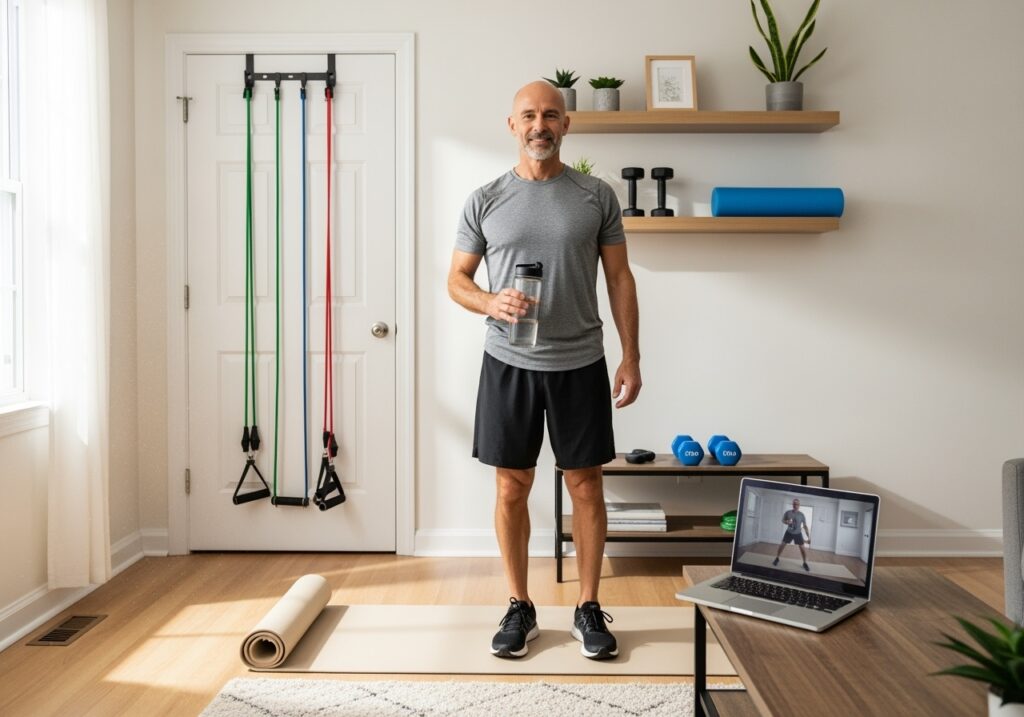
Flexible fitness systems are workout approaches that can adapt to your changing schedule, location, and energy levels. Instead of having one fixed routine, you have multiple options that all work toward the same goal.
For example, you might have:
- A full 45-minute gym session for when you have time
- A 20-minute bodyweight routine for busy days
- A 10-minute mobility sequence for travel days
The key is having these options ready before you need them. It’s like having a toolbox – you don’t use every tool every day, but you’re glad to have them when the situation calls for it.
Building Your Flexible Foundation
Start by identifying your non-negotiables. These are the minimum activities that make you feel like you’ve maintained your fitness momentum.
For most guys, this might be:
- 2-3 strength training sessions per week
- Some form of cardio 3-4 times weekly
- Daily movement (even if it’s just a walk)
Once you know your minimums, you can build flexibility around them. Consider investing in versatile equipment like resistance bands that travel well, or a suspension trainer that can turn any doorway into a gym.


The Minimum Effective Dose Strategy
Here’s a concept that’ll change how you think about summer workouts: the minimum effective dose. This comes from the principle that there’s a smallest amount of exercise that will produce the desired outcome. It’s like taking medicine – you need enough to be effective, but taking more doesn’t necessarily make it better.
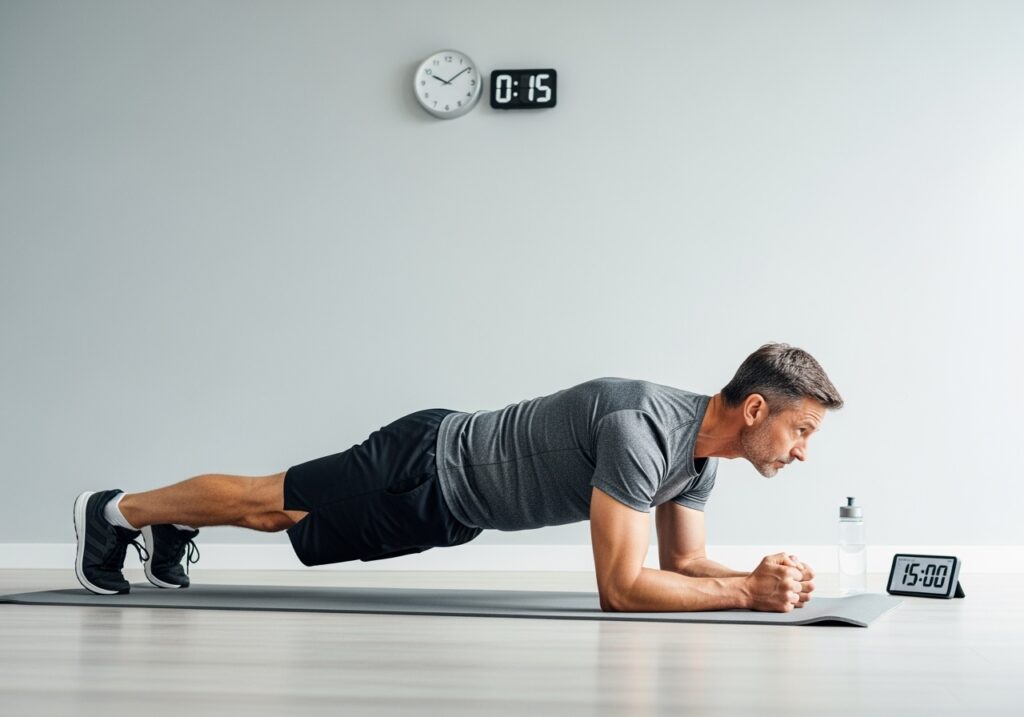
For maintaining your fitness gains during summer, your minimum effective dose might be surprisingly small. Research shows that you can maintain strength with as little as one workout per week per muscle group, and cardiovascular fitness with 2-3 sessions weekly.
This doesn’t mean you should always do the minimum – it means you have permission to scale back when life gets busy without feeling guilty about it. A 15-minute workout is infinitely better than a skipped workout.
Practical Minimum Effective Dose Workouts
The 15-Minute Strength Maintainer:
- 3 minutes warm-up
- 3 exercises, 3 sets each (push, pull, legs)
- 30 seconds rest between sets
- Examples: Push-ups, pull-ups, squats
The 20-Minute Cardio Keeper:
- 5 minutes easy warm-up
- 10 minutes of intervals (30 seconds hard, 90 seconds easy)
- 5 minutes cool-down
These routines work because they hit the major movement patterns and energy systems your body needs to maintain fitness. You can do them anywhere with minimal equipment.

Vacation and Travel Consistency Planning
Let’s be honest – vacation fitness planning often gets about as much attention as reading the terms and conditions on a software update. But with a little forethought, you can enjoy your time away without completely derailing your progress.

The secret to vacation fitness planning isn’t trying to maintain your exact home routine. It’s about adapting your approach to fit your new environment while still honoring your commitment to yourself.
Pre-Vacation Preparation
Before you leave, spend 10 minutes researching your destination:
- Are there walking paths or hiking trails?
- Does your hotel have a gym or pool?
- Is there space in your room for bodyweight exercises?
Pack smart fitness gear that doesn’t take up much space:
- Resistance bands (take up less room than a pair of socks)
- Jump rope (cardio anywhere)
- Suspension trainer (full-body workouts in hotel rooms)
During Your Trip
Embrace “vacation workouts” – they don’t have to look like your home routine. Consider:
- Morning walks to explore your destination
- Swimming if there’s a pool or beach
- Hiking local trails
- Hotel room bodyweight circuits
- Playing active games with family
The goal isn’t to maintain peak performance; it’s to keep your body moving and your habits alive. Consider it as “maintenance mode” rather than “improvement mode.”


Getting Back on Track After Disruptions
Here’s the reality: disruptions will happen. You’ll have a week where everything goes sideways, or a vacation where you barely moved. The difference between people who maintain long-term fitness and those who don’t isn’t that they never get disrupted – it’s how quickly they get back on track

Getting back on track after a fitness break is like getting back on a bike after not riding for a while. You might be a little wobbly at first, but the fundamentals are still there. The key is to resist the urge to jump back in at full intensity.
The 50% Rule
When returning from a break, start at about 50% of where you left off. If you were doing 3 sets of 10 push-ups, start with 2 sets of 5. If you were running 30 minutes, start with 15. This prevents injury and reduces the mental barrier to getting started again.
Your body has amazing muscle memory. You’ll be surprised how quickly you bounce back if you give yourself permission to ease into it.


Four Common Challenges and Solutions
Challenge 1
“My Schedule is All Over the Place”
The Problem: Summer schedules are unpredictable. Kids are home, work might be slower, and social events pop up constantly.
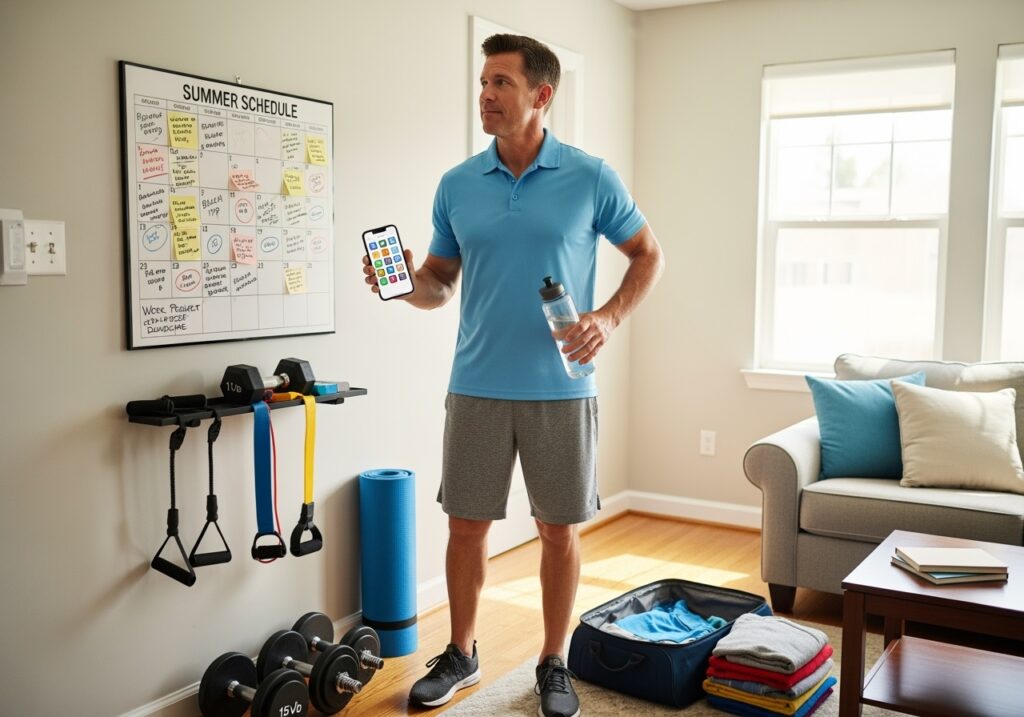
The Solution: Create time-based workout options. Have a 10-minute, 20-minute, and 45-minute routine ready. When you wake up, check your schedule and pick the one that fits. Use a fitness app or write them down so you’re not trying to figure it out in the moment.
Challenge 2
“I Don’t Want to Be Stuck Inside”
The Problem: Beautiful weather makes the gym feel like a prison.
The Solution: Take your workout outside. Bodyweight exercises work great in parks. Consider a portable pull-up bar for outdoor workouts, or use playground equipment for creative exercises. Running, cycling, and hiking are obvious choices, but don’t overlook outdoor yoga or calisthenics.
Challenge 3
“Vacation Completely Derailed Me”
The Problem: You had great intentions, but vacation turned into a week of indulgence and zero exercise.
The Solution: Plan a “re-entry” routine before you even leave. Schedule your first workout for the day after you return. Keep it simple and short – maybe just 20 minutes. The goal is to restart the habit, not make up for lost time. Consider a meal prep container set to get your nutrition back on track quickly.
Challenge 4
“I Lost All My Motivation”
The Problem: The summer heat, disrupted routines, and social pressures have killed your fitness motivation.
The Solution: Lower the bar dramatically. Commit to just 5 minutes of movement daily. It might be stretching, a short walk, or a few push-ups. The goal is to maintain the habit, not the intensity. Motivation often returns once you start moving again. A habit tracker can help you see your consistency visually.


Creating Your Summer Success System
The most successful approach to maintaining workout routine summer is to plan for imperfection.
Here’s your simple first step:
- Define Your Minimums: What’s the least you can do and still feel good about your effort?
- Prepare Multiple Options: Have workouts ready for different time constraints and locations.
- Pack Smart: Invest in portable equipment that travels well.
- Plan Your Comebacks: Decide in advance how you’ll handle disruptions.
- Track Simply: Use a basic method to monitor consistency, not perfection.
Remember, the goal isn’t to have a perfect summer – it’s to have a consistent one. Some days you’ll crush a full workout, other days you’ll take a walk. Both count toward your long-term success.

Related Articles


Final Thoughts
The Long-Term Perspective
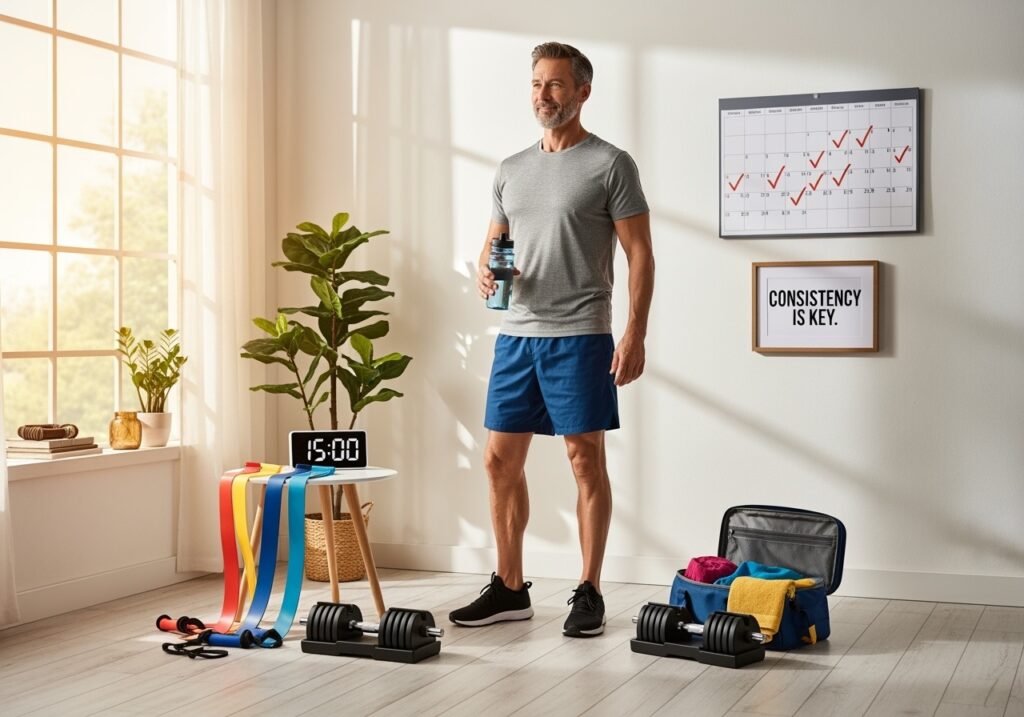
Summer fitness consistency is really about building a sustainable relationship with exercise that can weather any season – literally and figuratively. The habits you build now, the flexibility you develop, and the self-compassion you practice will serve you well beyond just these few months.
“Take care of your body. It’s the only place you have to live.”
– Jim Rohn
Consider investing in resources that support long-term consistency, like a good fitness book for motivation during tough times, or a quality water bottle that reminds you to stay hydrated during summer workouts.
Your 40s and 50s are the perfect time to master this balanced approach. You have the wisdom to know what works and the experience to adapt when it doesn’t. Use this summer as practice for creating a fitness approach that can handle whatever life throws your way.
Ready to maintain your gains this summer? Start by choosing one flexible workout option you can do anywhere, and commit to it for the next week. Your future self will thank you for the consistency, not the perfection.
Disclosure
This article contains affiliate links. If you choose to make a purchase through these links, we may earn a commission at no additional cost to you.
Important Note: The information in this post is meant to educate and inform, not to replace professional medical advice. While we’ve spent years studying health and wellness, we’re not licensed healthcare providers. Everyone’s body and circumstances are different, so what works for one person might not work for another. Always check with your doctor before starting any new exercise program or making significant lifestyle changes, especially if you have pre-existing conditions. By reading and using this information, you’re taking responsibility for your own health decisions.