How to Break Through a Fitness Plateau After 40: Proven Strategies That Work
You’ve been showing up consistently—hitting the gym three, four, maybe five times a week. You’re watching what you eat, getting decent sleep, and doing everything the fitness gurus tell you to do. But here’s the frustrating part: the scale hasn’t budged in weeks, your lifts feel stuck, and that energy you had when you started? It’s fading fast.
If this sounds familiar, you’re dealing with what’s called a fitness plateau—and it’s incredibly common for men over 40. Your body isn’t broken, and you haven’t lost your edge. What’s happening is your body has adapted to what you’re doing, and now it needs something different to keep progressing.
“The only way to make sense out of change is to plunge into it, move with it, and join the dance.”
– Alan Watts
The good news? Breaking through a fitness plateau after 40 is totally doable when you understand what’s actually happening and make some strategic adjustments. As we explore in The Over-40 Body Reset, these challenges are unique to our age group, but they’re far from insurmountable. Let’s dive into why plateaus happen and, more importantly, how to bust through them.
Disclosure
This article contains affiliate links. If you choose to make a purchase through these links, we may earn a commission at no additional cost to you.
Understanding Why Fitness Plateaus Happen After 40
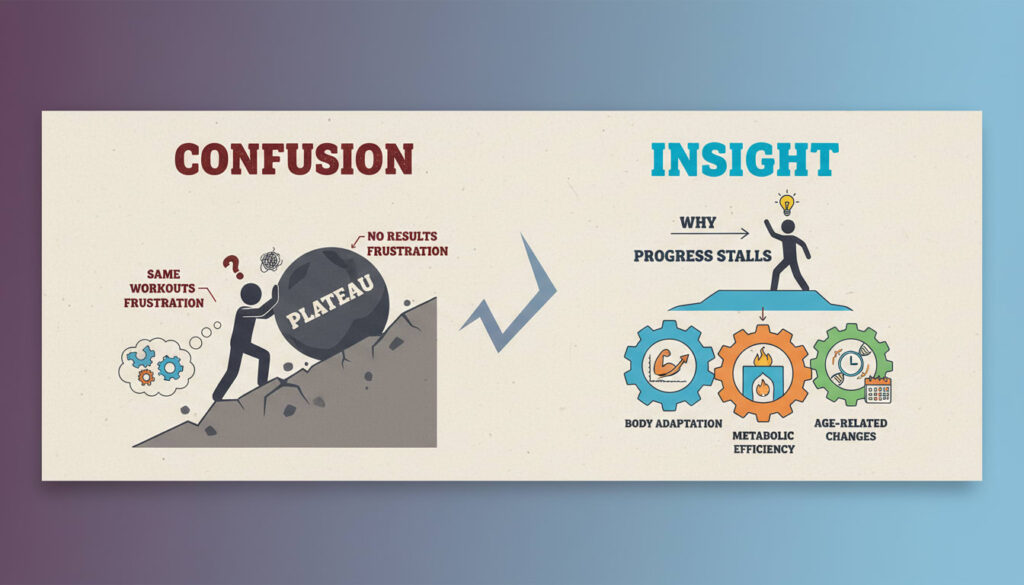
Before we jump into solutions, let’s talk about what’s actually going on inside your body. Understanding this isn’t just interesting—it’s essential for knowing how to fix it.
Your Body Is Smarter Than You Think
Your metabolism (the way your body burns calories and uses energy) is incredibly smart—maybe too smart. When you do the same workout routine for weeks or months, your body becomes more efficient at it. That means it burns fewer calories doing the same work and doesn’t need to build as much new muscle.
Think of it like when you first learned to drive. Remember how exhausting it was? You had to think about every movement—checking mirrors, using turn signals, adjusting speed. Now you can drive to work almost on autopilot while thinking about your day. Your body does the exact same thing with exercise. What once challenged you becomes routine.
The 40+ Factor
As we discuss in The Triangle of Well-being: How Health, Mind, and Money Connect, physical changes after 40 are deeply interconnected with your overall wellness. Here’s what’s working against you (and how we’ll work with it):
Hormonal Changes: Your testosterone levels naturally decline about 1% per year after 30. This affects muscle building and recovery. It’s not an excuse—it’s just biology we need to account for.
Recovery Takes Longer: That soreness that used to disappear overnight? Now it hangs around for days. Your body needs more time to repair and rebuild between workouts.
Metabolic Adaptation: Your body becomes incredibly efficient at conserving energy. While this was great for our ancestors during food shortages, it’s not helpful when you’re trying to lose weight or build muscle.
Muscle Loss (Sarcopenia): Without resistance training, you naturally lose 3-5% of muscle mass per decade after 30. Less muscle means slower metabolism, which means fewer calories burned at rest.
The key takeaway? This isn’t about working harder—it’s about working smarter and balancing all three pillars of wellness.
Breaking Through: Strategic Approaches to Restart Progress
Now let’s get into the practical stuff—the actual strategies that will help you break through that frustrating plateau.
Strategy #1: Change Your Training Variables
What this means: Instead of doing the same exercises, sets, and reps every workout, you’re going to mix things up strategically.
Why it works: Your body adapts to specific stress. When you change the stress, your body has to adapt again—which means progress.
How to do it:
Adjust Your Rep Ranges
- Been doing 3 sets of 10 reps forever? Try 5 sets of 5 reps with heavier weight
- Or flip it: 2 sets of 20 reps with lighter weight
- Change your rep range every 4-6 weeks
Change Your Exercise Selection
- Swap barbell bench press for dumbbell press
- Replace back squats with front squats or goblet squats
- Try different angles: incline instead of flat, or sumo stance instead of conventional
Modify Your Tempo
- Slow down the lowering phase (eccentric) to 3-4 seconds
- Add pauses at the bottom of movements
- Try explosive lifting on the way up

GAIAM 3-in-1 Resistance Band Kit

FEIERDUN Adjustable Dumbbells
Strategy #2: Progressive Overload 2.0 (Gradually Challenging Your Body More)
What this means: Progressive overload simply means gradually making your workouts harder over time. But there’s more than one way to do this.
Think of it like this: if you always lift the same 20-pound dumbbells for the same number of reps, your body gets used to it—like driving the same route to work every day. To see progress, you need to change things up.
Ways to progressively overload (pick one per workout):
- Add Weight: Increase by 2.5-5 pounds when you can complete all sets with good form
- Add Reps: If you’re doing 3 sets of 8, work up to 3 sets of 12 before adding weight
- Add Sets: Go from 3 sets to 4 sets of the same exercise
- Reduce Rest Time: Cut your rest from 90 seconds to 60 seconds between sets
- Increase Range of Motion: Go deeper into squats or add a stretch at the bottom of movements
- Improve Form: Perfect your technique—this actually makes exercises harder
Pro Tip: Keep a simple workout log. It doesn’t need to be fancy—a small notebook or notes app on your phone works great. Track your exercises, weight, sets, and reps. This is your roadmap for progress.

Clever Fox Wellness Planner
As we explore in The Power of Progressive Mindset: Small Wins to Major Breakthroughs, success requires both physical and mental adaptation. Small, consistent improvements compound into major results.
Strategy #3: Optimize Your Recovery (Give Your Body Time to Rebuild)
Here’s something most guys over 40 get wrong: they think more workouts equal more results. But your body doesn’t get stronger during workouts—it gets stronger during recovery.
What recovery optimization means: Giving your body what it needs to repair and get stronger between workouts. This isn’t about being lazy—it’s about being strategic. Think of your body like a smartphone: if you never charge it, it dies. Recovery is your charging time.
Recovery Essentials:
Sleep (The Non-Negotiable)
- Aim for 7-9 hours per night
- This is when your body releases growth hormone and repairs muscle tissue
- Poor sleep = poor recovery = plateau city

Manta Sleep Mask - 100% Light Blocking
Strategic Rest Days
- Take at least 2 full rest days per week
- “Rest” doesn’t mean couch potato—light walking, stretching, or yoga counts
- Listen to your body: if you’re unusually sore or tired, take an extra day
Active Recovery
- Light cardio (walking, easy cycling) on rest days increases blood flow to muscles
- Helps clear metabolic waste and speeds recovery
- Keep it easy—you should be able to hold a conversation
Nutrition Timing
- Eat protein within 2 hours after workouts (20-40 grams)
- Don’t skip meals—your body needs fuel to rebuild
- Stay hydrated: aim for half your body weight in ounces of water daily

TriggerPoint Grid 1.0 Foam Roller

TheraGun Therabody Prime Therapy Massage Gun
For more on maximizing your energy throughout the day, check out Energy Management for Men Over 40: Master Your Life.
Strategy #4: Nutrition Adjustments That Actually Work
Your workout stopped working might actually be a nutrition problem. Here’s what to check:
Protein Intake
- Target: 0.7-1 gram per pound of body weight
- Example: If you weigh 180 pounds, aim for 125-180 grams of protein daily
- Spread it throughout the day (20-40 grams per meal)
Why it matters: Protein is literally the building block of muscle. Without enough, your body can’t repair and build new tissue, no matter how hard you train.
Calorie Cycling
- Eat slightly more on training days (add 200-300 calories)
- Eat slightly less on rest days (reduce 200-300 calories)
- This prevents metabolic adaptation while supporting recovery
Carb Timing
- Eat most of your carbs around workouts
- This fuels performance and aids recovery
- Don’t fear carbs—they’re not the enemy

Flip 7 Chocolate Courage Feel better, fast with one shake a day. FLIP 7 is an unmatched, all-in-one meal replacement SUPER FOOD powder with the most nutrient rich balance of health extending blends formulated to support whole body and mind wellness.
The 6-Week Plateau-Busting Protocol for Men Over 40
Ready for a structured plan? Here’s a proven protocol that works for real guys with real lives.
Week 1-2: Assessment and Strategic Reset
Your Mission: Identify what’s not working and establish baselines.
Action Steps:
- Track Everything for One Week
- Write down every workout: exercises, sets, reps, weight
- Log your food intake (use a free app like MyFitnessPal)
- Note your sleep hours and quality
- Record your energy levels (1-10 scale)
- Take Baseline Measurements
- Body weight (same time, same day each week)
- Progress photos (front, side, back)
- Key measurements: waist, chest, arms, thighs
- Performance benchmarks: max push-ups, plank time, or key lift weights
- Identify Your Weakest Link
- Not enough protein? Fix that first
- Same workout for months? Time to change it
- Sleeping 5 hours a night? That’s your priority
Week 1-2 Workout Adjustment:
- Reduce training volume by 20-30% (this is a strategic deload)
- Focus on perfect form and mind-muscle connection
- Add one new exercise to each workout
Week 3-4: Strategic Implementation
Your Mission: Implement changes and build momentum.
Action Steps:
- Increase Training Intensity
- Add 5-10% more weight to your main lifts
- Reduce rest periods by 15-30 seconds
- Add one extra set to your primary exercises
- Introduce New Training Stimulus
- Try a completely different workout split
- Add one short, effective workout routine you haven’t done before
- Incorporate supersets or circuits
- Dial In Nutrition
- Hit your protein target every single day
- Time your carbs around workouts
- Eliminate one food that’s not serving you

PrepNaturals 5 Pack 30oz Glass Meal Prep Containers
Week 5-6: Progress Acceleration
Your Mission: Push harder and measure results.
Action Steps:
- Progressive Overload Every Workout
- Add weight, reps, or sets each session
- Push yourself (safely) beyond what’s comfortable
- This is where stepping outside your comfort zone pays off
- Optimize Recovery Aggressively
- Prioritize 8 hours of sleep
- Add active recovery sessions
- Use foam roller or massage gun daily
- Re-Measure Everything
- Retake all baseline measurements
- Compare photos side-by-side
- Assess strength improvements
- Note energy and mood changes
Accountability Tool: Consider a fitness tracker or smartwatch ($30-400) to monitor activity, sleep, and heart rate. Even budget options provide valuable data. This helps with tracking systems that actually work.


Measuring Success Beyond the Scale
Here’s something crucial: the scale is a liar. Well, not exactly a liar, but it doesn’t tell the whole story.
As discussed in Mindset Mastery: Building Mental Toughness in Your Prime Years, tracking these comprehensive markers ensures you’re actually making progress:
Performance Metrics (The Most Important)
- Strength increases: Can you lift more weight?
- Endurance improvements: More reps or longer plank holds?
- Better form: Deeper squats or fuller range of motion?
Body Composition Changes
- How your clothes fit (often more telling than the scale)
- Progress photos (take them in the same lighting, same time of day)
- Measurements: waist, chest, arms, thighs
- Visual changes: more muscle definition, less belly overhang
Energy and Recovery
- How you feel throughout the day
- Sleep quality improvements
- Faster recovery between workouts
- Better mood and mental clarity
Health Markers
- Resting heart rate (lower is generally better)
- Blood pressure improvements
- Better blood sugar control
- Reduced inflammation and joint pain
Tracking Tool: A body tape measure ($5-10) is incredibly cheap and provides more useful data than a scale. Measure weekly at the same time.
3 Mistakes That Keep You Stuck
Let’s talk about what NOT to do—because avoiding these mistakes is just as important as implementing the right strategies.
Mistake 1
Doing More of What’s Not Working
If your current routine isn’t producing results, doing it more often won’t magically fix it. This is like trying to unlock your door with the wrong key—no matter how many times you try, it’s not going to work.
The Fix: Change the stimulus. Different exercises, different rep ranges, different intensity. Your body needs a new challenge, not more of the same challenge.
Mistake 2
Ignoring Recovery
Your body doesn’t get stronger during workouts—it gets stronger during recovery. When you work out, you’re actually breaking down muscle tissue. The growth happens when you rest, eat, and sleep.
The Fix: Treat recovery as seriously as you treat training. Schedule rest days like you schedule workouts. Prioritize sleep like it’s a performance-enhancing drug (because it basically is).
Mistake 3
Comparing Yourself to Your 20-Year-Old Self
Your body at 45 is different from your body at 25—and that’s okay. You’re not “broken” or “past your prime.” You’re just working with different biology that requires different strategies.
The Fix: Compete with who you were last month, not who you were 20 years ago. Progress is progress, regardless of where you started. Focus on staying consistent without sacrificing your life.

Doctors Best High Absorption Magnesium Glycinate
Quick Reference: Your Plateau-Busting Shopping List
Essential (Under $50):
- Resistance band set: $15-25
- Foam roller: $15-30
- Body tape measure: $5-10
- Workout journal: $8-15
- Total: $43-80
Recommended (Under $150):
- Everything from Essential list
- Whey protein powder: $20-40
- Sleep mask: $10-20
- Meal prep containers: $15-25
- Magnesium supplement: $10-20
- Total: $98-205
Premium (Under $500):
- Everything from Recommended list
- Adjustable dumbbells: $150-300
- Massage gun: $50-150
- Fitness tracker: $30-100
- Total: $328-755
Remember: You don’t need everything at once. Start with one or two items that address your biggest obstacle, then add more as you progress.
Your Breakthrough Starts Now

Here’s the truth: hitting a fitness plateau after 40 isn’t a sign you’re getting old or that you’ve lost it. It’s actually proof that your body adapted to what you’ve been doing—which means you were doing something right. Now it’s time to level up.
“Strength doesn’t come from what you can do. It comes from overcoming the things you once thought you couldn’t.”
– Rikki Rogers
Breaking through a workout plateau requires a strategic combination of changing your training variables, optimizing your recovery, and giving your body the challenge it needs to grow stronger. You don’t need expensive equipment, hours of free time, or a complete life overhaul. You just need to work smarter.
Start with one change this week. Maybe it’s:
- Adding an extra set to your main exercises
- Trying a new exercise you’ve been avoiding
- Going to bed 30 minutes earlier
- Tracking your protein intake
- Investing in one affordable tool that adds variety
Small adjustments compound into major breakthroughs. The guys who succeed aren’t the ones who make massive changes overnight—they’re the ones who make small, consistent improvements over time.
Your breakthrough is waiting. Time to claim it.
Ready to take the next step? Check out our complete guide to balancing fitness, mindset, and money after 40 for a holistic approach to lasting change.
Disclosure
This article contains affiliate links. If you choose to make a purchase through these links, we may earn a commission at no additional cost to you.
Important Note: The information in this post is meant to educate and inform, not to replace professional medical advice. While we’ve spent years studying health and wellness, we’re not licensed healthcare providers. Everyone’s body and circumstances are different, so what works for one person might not work for another. Always check with your doctor before starting any new exercise program or making significant lifestyle changes, especially if you have pre-existing conditions. By reading and using this information, you’re taking responsibility for your own health decisions.