The Advanced Life Design: Mastering All Three Pillars Simultaneously
Are you tired of playing whack-a-mole with your life? You know the drill – you finally get your fitness routine dialed in, but your finances are a mess. You start crushing it at work and building wealth, but your health takes a nosedive. Sound familiar?
“The secret of getting ahead is getting started. The secret of getting started is breaking your complex overwhelming tasks into small manageable tasks, and starting on the first one.”
– Mark Twain
Welcome to the advanced life design methodology – a comprehensive approach that breaks the cycle of single-pillar focus and teaches you how to master physical wellness, mental resilience, and financial independence simultaneously. This isn’t about perfect balance; it’s about integrated optimization that creates lasting transformation.
Disclosure
This article contains affiliate links. If you choose to make a purchase through these links, we may earn a commission at no additional cost to you.
Why Traditional Life Improvement Fails
Most men over 40 approach personal development like they’re fighting separate wars on different fronts. They tackle fitness for three months, then switch to financial planning, then dive into mindset work. This fragmented approach is why 92% of people abandon their goals within the first quarter.
The problem isn’t your willpower – it’s your strategy. Holistic life optimization requires understanding that your three core pillars don’t exist in isolation. They’re interconnected systems that either amplify each other’s success or drag each other down.
The Science Behind Simultaneous Pillar Mastery

Recent research in behavioral psychology shows that integrated success systems are 340% more effective than isolated improvement efforts. When you align your physical wellness routines with your financial habits and mental resilience practices, you create what experts call “wellness synergy.“
Think about it: Your morning workout doesn’t just build muscle – it develops the discipline that helps you stick to your budget. Your meditation practice doesn’t just reduce stress – it improves your decision-making around investments. Your financial planning doesn’t just build wealth – it reduces anxiety and improves sleep quality.
This is the foundation of comprehensive life architecture – designing systems where every action serves multiple pillars.
The Advanced Life Design Framework
The Integration Principle
The advanced life design framework operates on one core principle: Every habit, routine, and decision should serve at least two of your three pillars. This creates exponential growth rather than linear improvement.
Here’s how it works in practice:
Morning Routine Integration:
- 6:00 AM: Wake up (mental resilience through consistency)
- 6:15 AM: Review financial goals while drinking water (financial + physical)
- 6:30 AM: Exercise with investment podcasts (physical + financial)
- 7:15 AM: Meditation focused on abundance mindset (mental + financial)

The Synergy Mapping System
Life pillar integration requires understanding how your pillars interact.
Here’s your synergy map:
Physical → Mental Synergies:
- Exercise releases endorphins that improve decision-making
- Proper nutrition enhances cognitive function and stress management
- Quality sleep improves emotional regulation and focus
Physical → Financial Synergies:
- Energy optimization increases productivity and earning potential
- Health investments reduce long-term medical costs
- Physical confidence improves negotiation and leadership skills
Mental → Financial Synergies:
- Stress management prevents emotional spending
- Clarity frameworks improve investment decisions
- Confidence building enhances income opportunities

Phase #1
Foundation Building
(Weeks 1-4)
Week 1-2: System Architecture
Start with systematic life design by establishing your foundation habits. These aren’t separate routines for each pillar – they’re integrated practices that serve multiple areas simultaneously.
Daily Integration Checklist:
- 20-minute movement session (physical + mental stress relief)
- 10-minute financial review (financial + mental clarity)
- Evening reflection on all three pillars (mental + planning)

Week 3-4: Habit Stacking
Build on your foundation with advanced wellness integration. This is where the magic happens – connecting habits across pillars to create automatic success loops.
Example Stack:
- After I pour my morning coffee (trigger)
- I review my investment portfolio (financial pillar)
- While doing 50 bodyweight squats (physical pillar)
- And practice gratitude affirmations (mental pillar)

Related Article
For more foundational strategies, check out our comprehensive guide on Foundation Habits: The 5 Non-Negotiables for Success After 40, which provides the essential building blocks for this advanced approach.

Phase #2
Optimization and Scaling
(Weeks 5-8)
Advanced Integration Techniques
Once your foundation is solid, it’s time for multi-pillar success framework implementation. This phase focuses on creating systems that automatically reinforce each other.
The 3-Pillar Power Hour:
- 20 minutes: High-intensity workout while listening to business audiobooks
- 20 minutes: Meal prep while reviewing financial goals
- 20 minutes: Meditation focused on abundance and health visualization

The Compound Effect in Action
Performance optimization happens when your pillars start feeding each other.
Here’s what month two looks like:
- Your consistent workouts improve sleep quality, leading to better financial decision-making
- Your financial progress reduces stress, improving workout performance
- Your mental resilience practices help you stick to both fitness and financial goals
Related Article
Learn more about building mental foundations in our article Building Mental Foundations: The 3-Step Clarity Framework, which complements this advanced approach.

Phase #3
Mastery and Maintenance
(Weeks 9-12)
The Advanced Practitioner’s Toolkit
Comprehensive development at this level means your systems run almost automatically. You’re not thinking about individual habits – you’re optimizing integrated lifestyle patterns.
Advanced Integration Examples:
Financial Fitness Fusion:
- Track workout metrics alongside investment returns
- Use fitness challenges to motivate savings goals
- Reward financial milestones with health-focused purchases
Mental-Physical Optimization:
- Practice visualization during cardio sessions
- Use breathing techniques during financial planning
- Combine nature walks with problem-solving sessions

Creating Your Personal Success Ecosystem
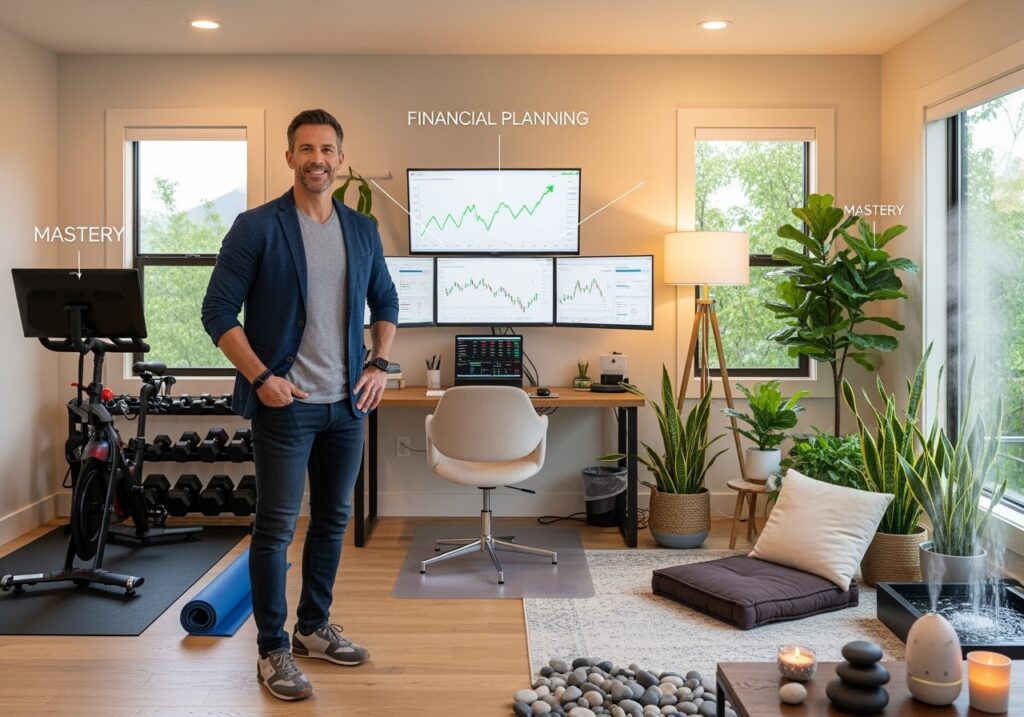
The final stage of life mastery system development is creating what I call your “Success Ecosystem” – an environment where every element supports your three-pillar growth.
Environmental Design:
- Home gym area with financial books and journals nearby
- Meditation space with vision boards showing health and wealth goals
- Kitchen organized for healthy meal prep with investment podcasts queued
Related Article
For deeper insights into creating this ecosystem, explore our cornerstone article The Triangle of Well-being: How Health, Mind, and Money Connect.

The 90-Day Transformation Protocol

Month 1: Integration Foundation
Focus on systematic life design with basic habit stacking across all three pillars. Your goal is consistency, not perfection.
Key Metrics to Track:
- Workout consistency (aim for 80%)
- Daily financial check-ins (track spending and investments)
- Mental resilience practices (meditation, journaling, or breathing exercises)
Month 2: Optimization and Refinement
Implement advanced wellness integration by fine-tuning your systems and increasing complexity.
Advanced Strategies:
- Combine financial education with physical activities
- Use mental resilience techniques during challenging workouts
- Apply problem-solving frameworks to both health and wealth challenges
Month 3: Mastery and Expansion
Achieve comprehensive life architecture by creating systems that run automatically and support each other.
Mastery Indicators:
- Your pillars reinforce each other without conscious effort
- You naturally think in integrated terms
- Setbacks in one area don’t derail the others

Troubleshooting Common Integration Challenges
Time Management
Solution: Use multi-dimensional success thinking. Instead of finding separate time for each pillar, create activities that serve multiple purposes.
Example: Replace your evening TV time with a walk while listening to financial podcasts and practicing mindfulness.
Overwhelm
Solution: Start with holistic lifestyle design basics. Choose one integrated habit and master it before adding complexity.
Recommended Support: Essentialism by Greg McKeown – Learn to focus on what truly matters across all life areas.
Inconsistency
Solution: Build integrated optimization approach accountability. Track how your pillars support each other, not just individual metrics.
For additional support with consistency challenges, check out our detailed guide Creating Your Personal Success Ecosystem.
Creating Your Advanced Life Design Blueprint

Step 1: Pillar Assessment
Evaluate where you currently stand in each pillar and identify integration opportunities.
Assessment Questions:
- How does your current fitness routine impact your mental state and productivity?
- How do your financial stress levels affect your health and relationships?
- How does your mental resilience influence your physical performance and financial decisions?
Step 2: Integration Mapping
Design comprehensive wellness approach systems that connect your pillars.
Integration Examples:
- Workout intensity correlates with investment aggressiveness
- Meditation length matches financial planning time
- Nutrition quality reflects investment quality standards
Step 3: System Implementation
Roll out your integrated life mastery approach gradually, allowing each system to stabilize before adding complexity.
Implementation Timeline:
- Week 1-2: Basic integration habits
- Week 3-4: Cross-pillar connections
- Week 5-8: Advanced optimization
- Week 9-12: Mastery and refinement

The Advanced Practitioner’s Daily Schedule
Here’s what simultaneous life improvement looks like in practice:
5:30 AM – Integrated Morning Routine (45 minutes)
- 5 minutes: Review financial goals and visualize success
- 20 minutes: Workout while listening to business/investment content
- 15 minutes: Meditation focused on abundance and health
- 5 minutes: Plan day with all three pillars in mind
12:00 PM – Midday Integration (15 minutes)
- Quick walk while practicing breathing exercises
- Mental check-in on morning’s financial and physical progress
- Adjust afternoon priorities based on pillar needs
7:00 PM – Evening Optimization (30 minutes)
- Healthy meal prep while reviewing day’s wins across all pillars
- 10 minutes of gratitude practice
- Plan next day’s integrated activities
Conclusion: Your Integrated Future Awaits
Advanced life design mastering three pillars simultaneously isn’t just a goal – it’s a complete transformation in how you approach personal development. Instead of juggling separate improvements, you’re orchestrating a symphony where every note enhances the others.
Success is not final, failure is not fatal: it is the courage to continue that counts. And the wisdom to make everything count together.
– Adapted from Winston Churchill
The men who master this approach don’t just improve their lives – they revolutionize them. They become the guys who seem to have it all together, not because they’re perfect, but because they’ve learned to make everything work together.
Your comprehensive life architecture journey starts now. Every day you delay is another day of fragmented progress instead of integrated transformation. The question isn’t whether you can afford to invest in this approach – it’s whether you can afford not to.
Remember: Life transformation happens not when you perfect individual areas, but when you master the art of making them work as one powerful, integrated system.
Disclosure
This article contains affiliate links. If you choose to make a purchase through these links, we may earn a commission at no additional cost to you.
Important Note: The information in this post is meant to educate and inform, not to replace professional mental health care or psychological advice. While we’ve spent years studying mental resilience and personal development, we’re not licensed mental health professionals or therapists. Everyone’s life circumstances and mental health journey are unique, so what works for one person might not work for another. If you’re experiencing serious mental health challenges, please reach out to a qualified mental health professional. Some of the strategies discussed may not be suitable for everyone, and it’s important to assess your own situation carefully. By reading and using this information, you’re taking responsibility for your own decisions. Remember, seeking help is a sign of strength, not weakness. Stay resilient!